


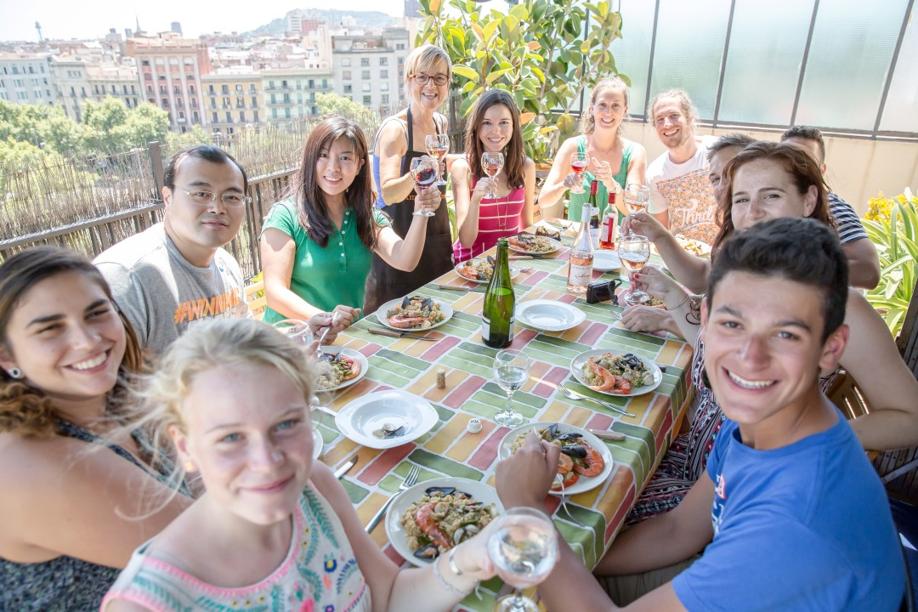
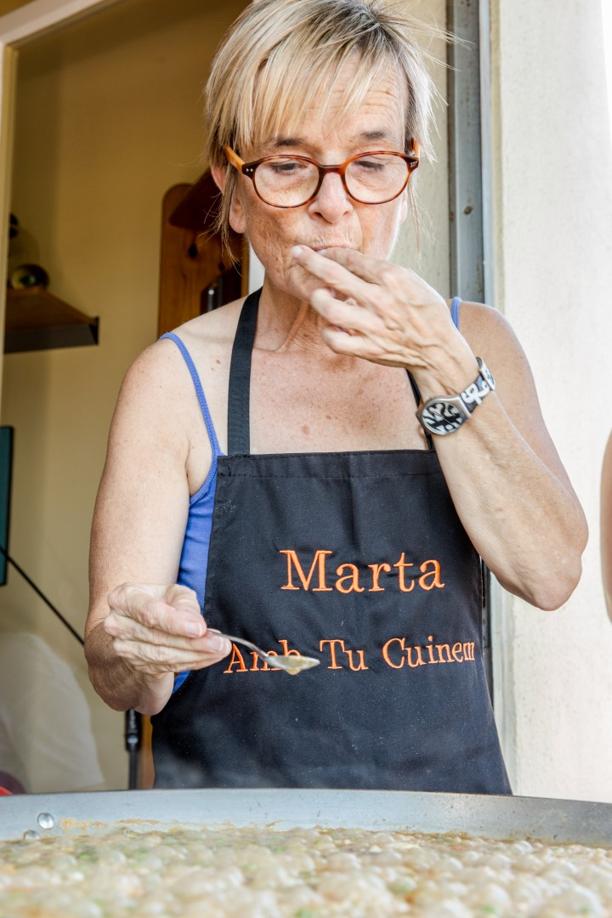
‘Today we’re going to learn how to make paella. Not just paella. A good paella,’’ says Marta Amb Tu Cuinem as she address the 10 strangers who have gathered around the kitchen table in her Barcelona flat. The cheery space is filled with an array of students from various corners of the globe — a couple from Beijing, some Spanish exchange students, a Barcelona native, and several groups of Americans. On the table sits an array of various sized bowls housing the ingredients needed for today’s demonstration. Cuinem goes around the table and picks them up, one at a time, explaining how the head-on prawns, Montserrat tomatoes from the local La Boqueria market, and large rubbery cuttlefish will be essential to bringing her beloved dish to life.
The animated teacher pauses to buzz a few latecomers into her building then continues on. “It’s a Sunday meal,’’ she explains. “Americans BBQ; we eat paella.’’ Cuinem tells the class that the meal, which originated in the south Catalonian region of Valencia, is best enjoyed on a day of leisure. It takes patience to prepare but is well worth the wait. She pulls out a giant paella pan, sets it up on her balcony, and gets to work. But the instructor doesn’t just cook for her students while they watch; her class is an immersive endeavor where everybody gets involved.
The experience is part of a new culinary craze where tourists sign up to enjoy home cooked meals around the world. Cuinem’s class is hosted on www.EatWith.com, a popular website that pairs food-obsessed travelers with individuals that have an affinity for cooking their local faire. Currently, the opportunity is offered in more than 150 cities, including Tel Aviv, Chicago, Los Angeles, and Budapest, and allows foodies the chance to visit the home of a chef and sample local dishes of the region. For instance, for $44, you can attend a four-course dinner party in Vancouver where mechanical-engineer-turned-home-chef, Samson, will prepare a tasting menu of whipped vanilla cream cheese wontons topped with a berry compote, a seasonal salad, Ontario-grown Cumbrae farm ribsteak, and a custard tart. Or, for a measley $17, a couple in Warsaw promises a course of “homemade pierogies that taste like “none that are offered in restaurants.’’ Cuinem’s specialty is the Spanish dish of paella, and her spin on the experience is that she allows her participants the opportunity to get hands on and assist her in the preparation and cooking process. She charges $43 per person for Marta’s Famous Paella Cooking Class.
After a quick demo on how to remove the teeth from the cuttlefish and properly skin a tomato, Cuinem’s students begin to chop everything from green peppers to onions and sausage. Then, someone is instructed to go and check on the fish stock, which is simmering on the stovetop. While using premade stock is perfectly fine, if she has it her way, Cuinem will make it from scratch. She reveals that her go-to routine for whipping up a batch involves filling a pot with water, onions, garlic, tomatoes, and leeks. “Chop up the vegetables, brown them in olive oil, toss in a little salt, pepper, and Spanish paprika and then throw them into the water along with fish bones and heads. You can pick those up at your local market or seafood store,’’ she reveals. “Once the water starts boiling, set the timer for 30 minutes.’’
When the veggies are prepped, the class relocates to the balcony, where Cuinem fires up the pan. Here they are given a brisk warning on how choosing rice can make or break the dish. “Basmati, Jasmine, and long grain are a no-no for paella,’’ Cuinem says. “I don’t want my rice to cook in five minutes. Five minutes won’t be enough time to absorb all the liquid and get the flavor from everything else. Always use a short grain.’’ And when it comes to paella, Cuinem stresses that no expenses should be spared. “Always, the most expensive rice goes into your paella,’’ she says with a grin. Olive oil is added to the pan, and one-by-one, the ingredients are cooked, removed, and set aside in bowls. Then the green pepper, onions, garlic, and tomatoes are summoned to create the base of the dish, known as the sofrito. “This is the big moment,’’ exclaims Cuinem proudly. “If you make a good sofrito, you have 50 percent guarantee of a good paella.’’ To pull this off, the vegetables, which were previously chopped into tiny pieces, are sautéed for 20 minutes on low heat. “I am going to cook it so much it’s going to be almost like a paste,’’ she explains. “This is the base of many of the native dishes of Spain, so it’s one you learn to perfect.’’
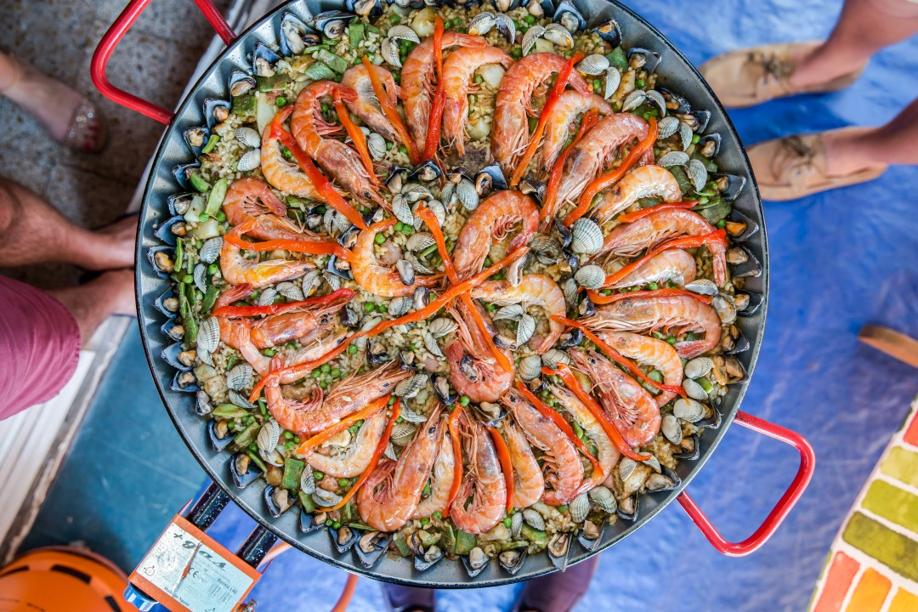
The rice is added to the pan and stirred to make sure that every single grain is coated with sofrito. “From this point on, don’t touch it,’’ says Cuinem. “We initially stir the rice to get all the juices on it and then leave it be.’’ Fish stock is added, followed by the rest of the ingredients. Cuinem instructs her helpers to set the table. Bottles of cava are removed from the fridge and opened on the table. “We are almost ready to eat!’’ she announces. Everyone cheers and is wrangled to decorate the dish. Hands start grabbing for mussels, prawns, clams, and shrimp to arrange them artfully around the perimeter of the dish. A final layer of roasted red peppers is scattered on top and Cuinem steps back to admire her work. “Look how cute the little green peas make it look!’’ she exclaims. She covers up the pan, lets it “rest’’ for five minutes, and then finally it is time to eat.
Cuinem dishes out paella for her hungry participants. She then commands her students to raise glasses and cheer their efforts. After one taste, the balcony unanimously declares this the best paella they’ve ever tasted. Everyone leaves with a full belly, a print out of the recipe, Cuinem’s e-mail address, and assurance that she’s always available to answer Spanish-cooking related questions.
“Marta knows how to throw a good party,’’ says Jeff Schreier, an avid foodie who says he’s used techniques he learned from Cuinem in his own kitchen since returning home to New York.
“I’ll never forget that day because it was my top memory from the vacation,’’ adds Emily Fleishaker. “I walked away with new friends, a light buzz, and one extraordinary paella recipe!’’
 PREVIOUS ARTICLE