


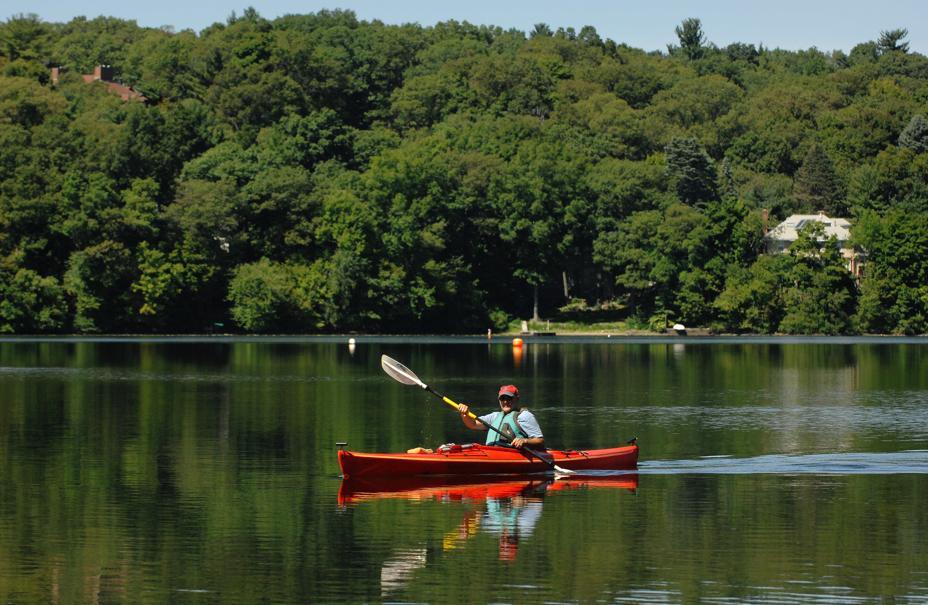
A newly released report card on water quality gives top grades to Upper Mystic Lake and the Mystic River, but flunks three smaller rivers and brooks that run through Belmont, Everett, and Chelsea.
The analysis of water bodies within the Mystic River Watershed released Tuesday found a wide variation at different stretches of river and tributaries, according to the US Environmental Protection Agency, which prepared the report with the Mystic River Watershed Association.
“There are parts of the watershed that are quite good where you can swim and boat and other parts that have much lower grades, where we need to do a lot more work,’’ said Lynne Hamjian, deputy director of the Office of Ecosystem Protection for the EPA’s New England office.
Water quality in the main stem of the Mystic River, including the Upper and Lower Mystic Lakes and extending through Medford Square to Boston Harbor, remains relatively good on a regular basis, the analysis showed.
But many streams feeding the Mystic often do not meet water quality standards.
Following a more comprehensive approach begun last year, the EPA issued separate grades for 14 segments of the watershed. Previously, the agency provided an overall grade for the watershed.
Grades are based on bacterial contamination found in samples collected monthly by watershed association volunteers at 15 sites, and data gathered at numerous locations by the Massachusetts Water Resources Authority. The grades reflect the rates at which the sampled water met standards for swimming and boating, averaged over a three-year period.
Upper Mystic Lake, located in Arlington, Medford, and Winchester, earned the highest grade with an A+ based on meeting water quality standards 95.9 percent of the time. The salt water section of the Mystic River — the area south of the Amelia Earhart Dam in Everett and Somerville — and Chelsea Creek, in Chelsea — were next highest with A- grades.
Also gaining relatively high marks were the fresh water section of the Mystic River — the area north of the dam in Arlington, Medford, and Somerville — which received a B+; and Belle Isle Inlet, in East Boston and Winthrop, which showed the greatest improvement since last year, climbing from a C to a B.
Areas earning low marks included Alewife Brook in Arlington, Cambridge, and Somerville, and Mill Brook, in Arlington, both of which received a D; Little River, in Belmont and Cambridge, which earned a D-; and Mill Creek, in Chelsea, Winn’s Brook, in Belmont, and Island End River, in Everett and Chelsea, all of which received an F.
In all, 10 of the 14 areas saw water quality improvements since last year, with four of those earning higher grades.
The EPA said that investigations to date indicate that the main causes of high bacteria counts in areas receiving poor marks are illicit sewer discharges to storm drain systems and uncontrolled urban storm-water runoff that contains pet and animal waste.
Both the EPA and the state Department of Environmental Protection have been pursuing active enforcement strategies to improve water quality throughout the watershed.
Included are efforts to stop illicit connections to storm drains that since 2005 have resulted in the removal of more than 31,800 gallons per day of sewage discharges into the Mystic River, according to Hamjian. In addition, repairs have prevented tens of thousands of gallons of sewage from discharging into the river during rain events, the EPA said.
Further improvements are expected from a new federal permitting system governing municipal storm-water systems. Set to take effect July 1, 2017, it will include stronger requirements for cities and towns to monitor and repair illicit connections and to undertake other practices to reduce the level of pollutants from storm-water systems.
The MWRA is also planning measures to reduce sewer overflows during storm periods in the Alewife Brook area.
In a separate effort from the report cards, the EPA last summer launched a Mystic River water quality monitoring buoy in front of the Blessing of the Bay Boathouse in Somerville.
“We have a lot of ongoing work to improve water quality in the Mystic and its tributaries, and this report card serves as motivation to continue that work,’’ Curt Spalding, regional administrator of EPA’s New England office, said in a statement. “EPA and our partners are committed to improving water quality for residents of the Mystic Watershed, and while we have seen improvements, we still have a lot of work to do.’’
“It’s a great tribute to the dedication of these local activists who are helping to improve the local natural environment,’’ EkOngKar Singh Khalsa, executive director of the Mystic River Watershed Association, said of the volunteer water monitors.
“It just speaks to the difference passionate people can make in that we are seeing these improvements in areas where they are being celebrated, and are able to more clearly see where we still need to get work done.’’
John Laidler can be reached at laidler@globe.com.
 PREVIOUS ARTICLE