


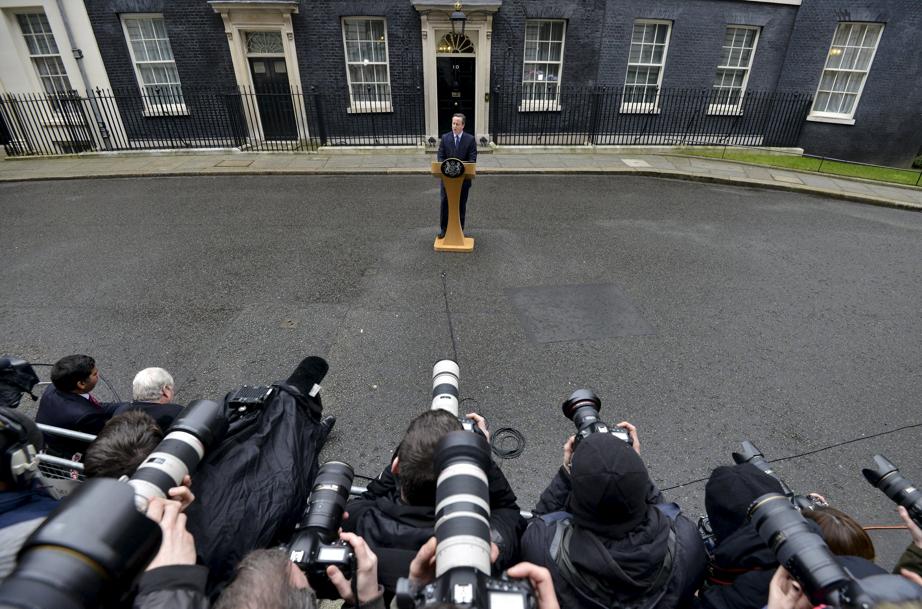
LONDON — Britons will vote on June 23 on whether to stay in the European Union or to quit, Prime Minister David Cameron said Saturday, announcing the date of a referendum that could have momentous consequences for his country, and for Europe.
Cameron made the announcement after presiding over a meeting of his Cabinet — which is divided over Europe — and hours after securing a hard-fought deal, which he said gave Britain “special status’’ in the 28-nation bloc.
“We are approaching one of the biggest decisions this country will face in our lifetimes,’’ Cameron said outside his office on Downing Street, adding that he would recommend a vote to stay. “Leaving Europe would threaten our economic and national security,’’ he added.
Highlighting the historic nature of the decision facing Britain, the Cabinet met for the first time on a Saturday in more than three decades, and talked for more than two hours.
A vote by Britons to exit would be a huge blow to the union, which has battled to control an economic crisis in its single-currency zone, and is confronted by a wave of migrants, prompted partly by the civil war in Syria.
For Britain, a withdrawal would have major implications, too, because it could lose automatic access to Europe’s single market, provoke economic uncertainty, and leave the country more isolated internationally. That risk was highlighted by Cameron, who described a British withdrawal as a “leap in the dark.’’
Yet the referendum remains a gamble for Cameron, who has often sounded critical of the European Union in the past, but has now shifted to support a bloc that he admits he does not love. On Friday, he made an impassioned plea to Britons to remain in the European Union, after securing his new deal, which covered a variety of economic, sovereignty, and welfare issues.
His most senior allies, including, significantly, Theresa May, home secretary, will support Cameron’s bid to stay inside the bloc.
Yet six Cabinet ministers made it clear Saturday that they will campaign for a British exit — known as Brexit.
The most significant of those is Michael Gove, a close ally and personal friend of Cameron whose decision personifies the fissures at the top of Cameron’s Conservatives. But uncertainty surrounds the position of Boris Johnson, mayor of London, whose support would be seen as a big asset by the “no’’ campaign because he is renowned as a communicator.
Johnson has not yet made his views clear, and his position is thought by many to be significant because the outcome of the referendum is hard to predict. Opinion polls suggest that the British public is split on the issue, and much of the news media has criticized Cameron’s renegotiation to change British ties with the union.
However, supporters of European Union membership hope that Cameron’s status as an election-winning prime minister will prove decisive in the referendum campaign, which will be the first British plebiscite on Europe since 1975. Then, Britons voted by a clear margin to stay in what was then called the European Economic Community, which they had joined in 1973.
Cameron returned to London late Friday after more than 30 hours of talks to secure a deal which, he said, was good enough to give Britain “the best of both worlds,’’ allowing the country to have the benefits of European Union membership while staying out of its single-currency and passport-free travel zone.
While not the fundamental shift in the relationship that Cameron once seemed to promise, the agreement struck in Brussels did give Britain some significant concessions and safeguards.
The talks proved so tough because several of Cameron’s demands appeared to contradict fundamental European Union principles, including the right of all Europeans to live and work in any member states with equal treatment.
In the end, the deal gave Britain an exemption from a treaty obligation to pursue “ever closer union,’’ one of the bloc’s most important, if symbolic, pledges.
Cameron also won the right to restrict, for four years, welfare entitlements for citizens from other European Union countries who come to Britain to work.
The deal also covered restrictions on child benefits.
Cameron also received safeguards to ensure that Britain’s financial sector would not face discrimination as a result of the fact that Britain did not join the euro currency, and kept the pound sterling.
 PREVIOUS ARTICLE