


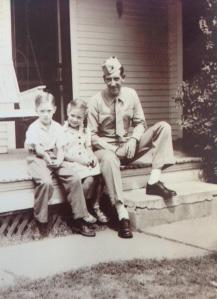
Larry Jodry was just a kid, living in Columbus, Ohio, when World War II broke out.
His parents worked different shifts at the Curtiss-Wright aircraft plant, building Helldiver bombers for the Navy.
His dad, Garnet Jodry, was 30 years old, with a wife and two kids at home, and his age and family status insulated him from the harsher realities of war. But by 1944, the Americans knew they had to throw everything at the Germans in Europe and the Japanese in the Pacific if the allies were going to prevail, so Garnet Jodry got drafted.
He went down to the recruiting office, determined to avoid the Army. He made a pitch to the Navy, but the Navy recruiter said he had filled his quota for that day. A Marine recruiter overheard the conversation and tapped Garnet Jodry on the shoulder.
“How about the Marines?’’ the recruiter suggested. “It’s part of the Navy.’’
That guy should have been selling cars because Garnet Jodry gladly signed up. Larry Jodry was 8 years old when his dad set off for Parris Island. His mom took the train down to South Carolina once during the training and came back to Ohio to report that the mess hall floors looked like glass.
Larry Jodry, his little sister, and their mother moved from Columbus to Mowrystown, a farming community in southern Ohio where his dad’s father lived. They wanted to be near family when his father went off to war.
In February of 1945, the Marines stormed the beaches on Iwo Jima. They kept sending wave after wave. On the eighth day of the battle, Garnet Jodry and the rest of the 4th Marine Division jumped off the landing craft. He had just made it to shore and was digging a foxhole on the beach when he was cut down by Japanese machine-gun fire.
The Marine from North Carolina who was digging with him later told the family that Garnet Jodry fell dead, instantly, on the black lava sand.
Sylvia Jodry was standing in her kitchen, looking out the window, watching the black Chevrolet creep slowly up the gravel driveway. A US marshal got out of the car carrying a telegram and knocked on the screen door. Larry Jodry remembers the sound of the door, bouncing off the jamb, as he remembers his mother melting in grief.
The telegram announcing that Marine Private Garnet Jodry had been killed in action was written in pencil and was dated March 20, 1945, Larry Jodry’s 9th birthday.
Garnet Jodry’s father decided that his son should be buried with his fallen comrades, in the 4th Marine Division cemetery on Iwo Jima, where some 7,000 Americans and 20,000 Japanese died in a battle that lasted five weeks. Sylvia Jodry wanted her husband’s remains returned, but her father-in-law’s wishes prevailed.
Families had three years to change their minds, and Garnet Jodry’s dad eventually did. His body was brought back and buried in Bell’s Run Cemetery on Highway 321, just outside Mowrystown.
Only one other man in their small town had been killed in the war, and he didn’t have kids, so Larry Jodry became the kid whose dad got killed in the war. Most people were considerate. But some kids teased Larry mercilessly for his disability, especially after they moved to a bigger town near Dayton. He was born with a right arm that was not fully developed, with a hand that had just two fingers.
Still, he was irrepressible. He tried out for his high school basketball team but was cut. He kept playing basketball and made his community college team. He didn’t just make the team. He averaged 7.8 points a game.
His mother never saw him play. His grandfather never saw him play. He always wondered, if his father had lived, would he have seen him play?
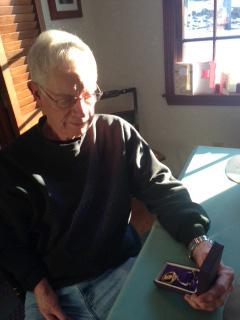
“I like to think he would have,’’ Larry Jodry says, sitting in his house in Chelmsford, the fading light spreading across his dining room table. “I’d like to think he’d have been proud of me.’’
But that’s what war does. It doesn’t just end lives. It ends certainty as it ends possibilities.
As he got older, Larry Jodry became aware of a series of wartime letters his father wrote to his grandfather, Maurice Jodry. It revealed a softer side of the man.
Maurice Jodry was a traveling salesman, a God-fearing, upright Presbyterian who taught Sunday school. Garnet Jodry smoked and liked to take a drink. It was just two of many things that came between father and son.
But, in those war letters, Garnet Jodry’s language took a decided turn. He was solicitous of his father, even kind. Their separation, the prospect of Garnet being killed in battle, had pushed aside their differences.
“My grandad said, ‘I should have helped Garnet more than I did,’ and my grandad was a hell of a guy,’’ Larry Jodry said. “When I read their letters, I saw them change. Grandad said he shouldn’t have been so critical of my dad. My dad said, ‘Maybe I should be more loving.’ “
War intervened too early for Larry Jodry to have that singular moment with his dad. Before the war, Garnet Jodry was a long-haul truck driver, and when he got home he was exhausted. He wanted to unwind and sleep more than play with his kids.
But Garnet Jodry’s last letter home to his son was warm.
“Daddy would like to see you,’’ he wrote. “I bet you are a big boy now. Lots of love. Your daddy.’’
Larry Jodry went on to graduate from college and become an engineer. He worked in the defense industry his entire career, most of it here in Massachusetts, where he moved in the 1960s, and spent 27 years with Raytheon.
He was married to the beautiful Ruth Anne, whom everybody called Mimi, for 50 years before she died in 2008, and they raised two sons. He’s had a great life.
But every year, when the anniversary of Iwo Jima rolls around, he remembers a father who died too young, what wars do to families, and the possibilities that lay buried in the black lava sand forever.
Kevin Cullen is a Globe columnist. He can be reached at cullen@globe.com. Follow him on Twitter @GlobeCullen
 PREVIOUS ARTICLE