


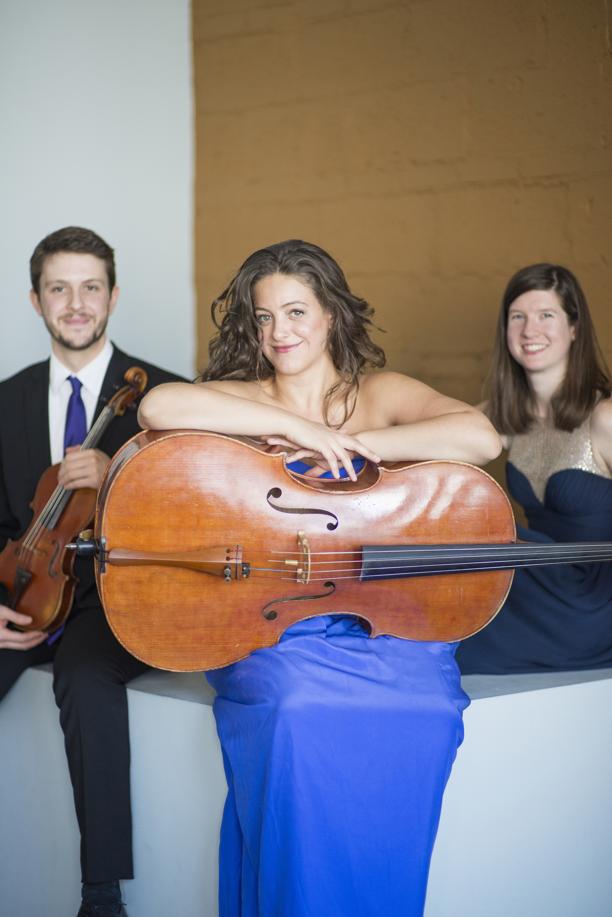
Trio Cleonice
At United Parish of Brookline, June 7 at 7 p.m. Tickets: free (donations benefit the United Parish music program). www.triocleonice.com
Gwen Krosnick once noticed something odd about piano trios that wasn’t true of, say, string quartets: Some of the best known were named for the last names of their members. Think Istomin-Stern-Rose, Kalichstein-Laredo-Robinson. That might seem superficial, but Krosnick, cellist of Trio Cleonice, thinks it’s symptomatic of a larger issue. “Which is that while a lot of people play trios very seriously, a lot of the attitude among string and piano players is much more soloistic, bravura, virtuosic,’’ she said during a recent conversation.
Needless to say, when Krosnick and her trio-mates – violinist Ari Isaacman-Beck and pianist Emely Phelps – formed their own group, they did no such thing. Their namesake is the Cleonice Mediterranean Bistro in Ellsworth, Maine, a favorite eating haunt (now closed) not far from Blue Hill, home of the Kneisel Hall Chamber Music School and Festival, where the three first met and played together.
Maine, fittingly, is where the trio will play its last few concerts this summer before disbanding after eight busy and imaginative years. Before that, they will give one final concert on Tuesday at United Parish of Brookline where, over three seasons, the Trio Cleonice and Friends series has become an adventure in mutually responsive exploration shared by musicians and audience.
Maine is but one geographical point in Cleonice’s narrative arc – another is New York, where the trio formed in earnest and played its first concerts in 2008. There was, Krosnick said, “a voracious enthusiasm’’ about the possibilities that were emerging. “We learned a lot of music that year. Maybe not all of it terribly well, but it was sort of finger-in-the-electrical-socket excitement.’’
Even more important, perhaps, is Boston, where the members moved in 2011 to take up residency in New England Conservatory’s Professional Piano Trio Program, run by pianist Vivian Hornik Weilerstein. Something interesting happened during that time of intensive study and coaching. Already serious chamber musicians, Krosnick, Phelps, and Isaacman-Beck were committed to a vision of the trio that was all about unity and balance, a kind of idealized selflessness in favor of a common goal. None of this three-soloists-with-their-last-names-on-the-group for them.
Even so, during those three years at NEC “there was a lot of time that was very much focused on finding our individual voices,’’ Krosnick explained. “What do I want to do on the cello, and how can that make, say, the Smetana Trio come even more alive?
“It’s funny, the evolution of that element,’’ she continued. “It’s not that we feel that it’s less important to really seriously work on ensemble or unification of certain elements. But if I think about a string quartet, the string quartets I love, it is so much about the dynamic between different, really strong voices.’’ (Her model for this kind of dynamic might be the Juilliard String Quartet, of which her father, Joel, has been cellist since 1974, and which he will leave later this month.)
So, why break up the band just when it seems to be hitting its stride?
There was silence, then a nervous laugh. “I thought I was gonna get away without that one,’’ Krosnick said with mock innocence. “I thought we were just having a nice conversation about chamber music.’’
The decision, she explained, involved a growing awareness of the importance of things in each member’s life outside the trio. Phelps determined that it was time to pursue a doctoral degree in piano performance, which she will begin at Stony Brook University this fall. Krosnick and Isaacman-Beck discovered they each had been thinking about and working on Bach’s solo music for their respective instruments, and are now planning a concert series, also in Brookline, that mixes Bach with music by the American composers they’ve championed in Cleonice programs: Richard Wernick, Ralph Shapey, Elliott Carter, Roger Sessions. The pair also plan to form a string quartet.
Those are things, Krosnick said, that she wouldn’t have conceived, or even given herself the space to conceive, with the trio taking center stage in her artistic endeavors. And they weren’t there when the decision to end Cleonice was made. But, she said, “you probably know this feeling of, I’m not sure what’s ahead of me if I get rid of this thing that’s been really central. But I think there might be something good. There’s a freedom and an excitement of freedom that opens up.’’
And so a group that came into its own when its members discovered that their unique qualities were as important as the totality will, in a sense, go out the same way: by letting their own artistic personae guide them toward whatever lies ahead.
“It’s about continuing the work on our own voices,’’ Krosnick said, “and seeing the next phase that that carries us to.’’
David Weininger can be reached at globeclassical notes@gmail.com. Follow him on Twitter @davidgweininger.
 PREVIOUS ARTICLE