


RIO DE JANEIRO — The only feeling worse than the agony of defeat is the agony of not being allowed to compete.
Olympic 100-meter sprinter Andrew Fisher, running for Bahrain by way of Jamaica, and French 110-meter hurdler Wilhelm Belocian both experienced such agony here in Rio. They were disqualified after premature acceleration in the starting blocks.
As an Olympic neophyte, I’m encountering sports and rules I’m unfamiliar with and don’t fully understand. But the most detestable rule is the unyielding precept that one false start results in an automatic disqualification. It’s used in track and swimming events.
Athletes who spend four years pouring their hearts, minds, bodies, and souls into an Olympic dream deserve a second chance to do what they came to do: compete on the Olympic stage.
The one-and-done false start looks like it was written by Roger Goodell. It is more unforgiving than Patriots coach Bill Belichick stiff-arming a potential quarterback controversy. It’s a rule only John Calipari could love.
The rule is the answer to a riddle: How is half a second a more significant measure of time than four years?
Can you imagine if this type of rule existed in other sports?
What if Rob Gronkowski got the snap count wrong in the Super Bowl and was thrown out of the game? What if LeBron James went too early trying to steal a tip following a jump ball call and was sent to the showers in a Game 7? What if Mookie Betts left the batter’s box too early and was not only out on the play, but out of the game?
Absurd.
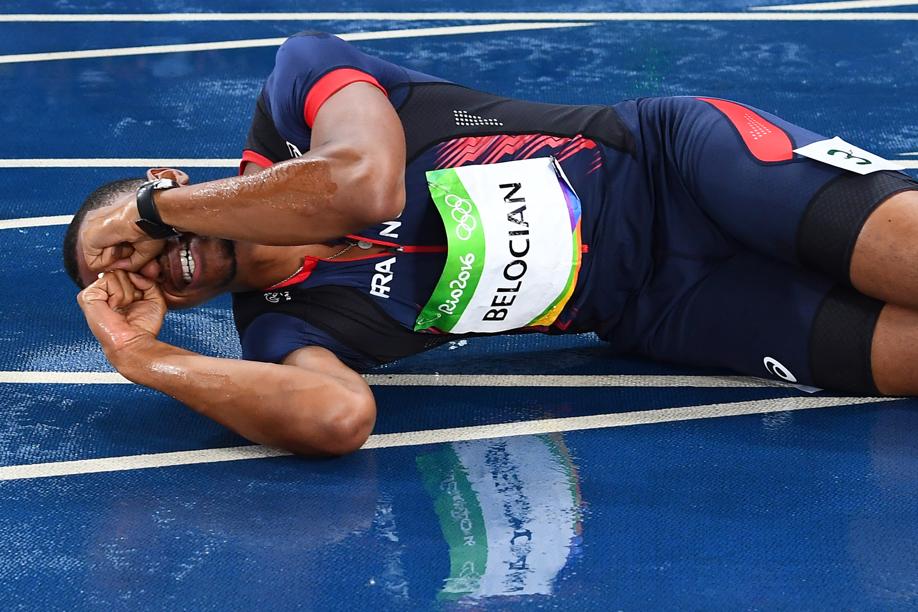
Belocian had one of the signature heartbreak moments of these Games on Monday night, when he false-started on a wet track in the fourth heat of the men’s 110-meter hurdles, the same heat that had American Devon Allen.
The images of Belocian’s anguish, despondence, and despair after being eliminated from the Olympics without even taking an official step went viral.
The 21-year-old, who finished third at the European Championships and was a good bet to make Tuesday’s semifinals, pushed over hurdles, knelt on the track as though he were praying for absolution, and departed in stunned tears.
His temper tantrum wasted more time than simply sending him back to the blocks and restarting the race would have.
Fisher false-started in the 100-meter men’s semifinals Sunday night. His reaction was not as visceral, but his dejection over his ejection was obvious.
He blamed his false start on a helicopter hovering over the track, trying to get a closer look at Usain Bolt. His excuse is no lamer than the rule.
Fisher is a perfect example of how silly and sanctimonious the false start rule used by the International Association of Athletics Federations is.
The IAAF allows athletes like Fisher, who still lives in Jamaica and has been to Bahrain once by his account, to swap countries the way they swap socks. But there’s no tolerance for jumping the gun, even if you’re the mighty Bolt.
Bolt false-started in the final of the 2011 World Championships in Daegu, South Korea, and was disqualified.
If that had happened on Sunday night at the Olympic 100-meter final, there would have been a revolt in Rio. There’s nothing like crowning the world’s fastest man by default.
The false start rule in swimming and in track should be amended for the heats, so athletes can at least have a chance to compete in the Games, instead of being sent home for a split-second mistake. If you want to revert to one false start once athletes reach the semifinals and the final, sigh, so be it.
In the heats, the first false start should be charged to the field. The next one by anyone results in a DQ.
This used to be the way the rule worked in all rounds for track.
The IAAF adopted the one-and-done rule in 2010 for the most odious of reasons: television.
Television partners around the world, where “athletics’’ is a major sport outside of the Olympic window, were upset that track competitions weren’t fitting in their tidy little viewing windows. Athletes were jumping the gun and delaying races.
No, no, let’s not make it about the athletes. It’s about broadcasters and viewers.
Here’s a thought. If you as a viewer think a particular track or swim meet is taking too long, just turn the channel or fire up Netflix. You have far, far less invested than the athletes at the starting blocks.
(Swimmers were previously allowed two false starts per athlete. FINA, the governing body of international swimming, changed it to one for the 1999 World Championships.)
Far more educated track observers have pointed out that when the rules were more lenient, athletes took advantage of them. They would intentionally false start to try to steal some time or slow down a rival by endangering the entire field for the next falsie.
Perhaps the IAAF should allow officials to determine whether a false start was intentional.
That’s ripe for second-guessing and geopolitical intrigue, but it’s still better than uncompromising ironclad disqualifications.
The intractable false-start rule not only robs athletes of the chance to compete, but it can rob spectators of blazing times. If athletes are extra cautious, you’re going to get some slower starts and slower times.
Athletes are not perfect. Rules that require them to be are nothing but the bureaucratic red tape of sports. I hate red tape.
One look at the red eyes of a distraught Belocian told you that the one false start rule is not in the true spirit of the Olympic Games.
Christopher L. Gasper can be reached at cgasper@globe.com. Follow him on Twitter @cgasper.
 PREVIOUS ARTICLE