


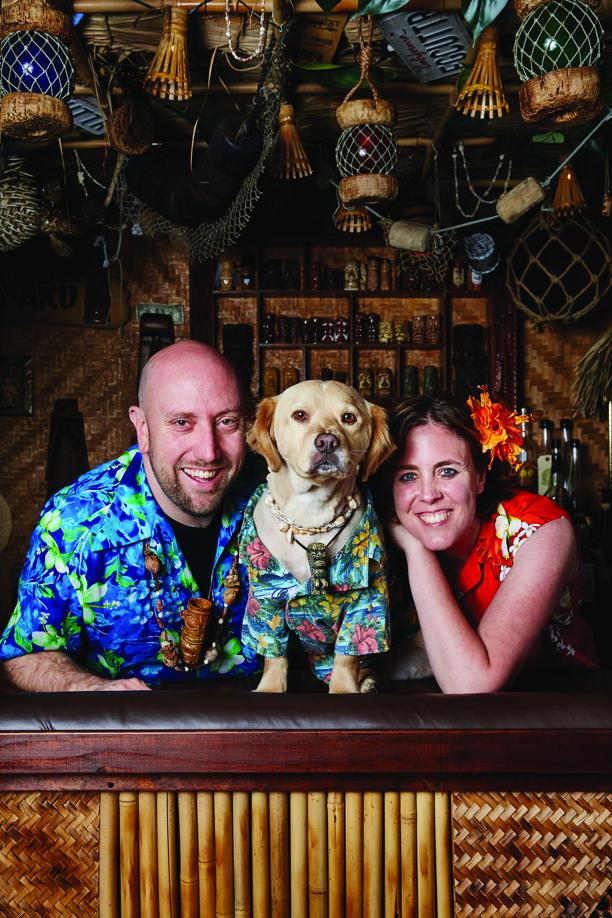
When some viewed tiki bars as fading relics, Martin Cate saw something different amid the fake palms and flaming statues. He saw artistry, complex cocktails, and the link to an exciting part of America’s past. Along with his wife, Rebecca, he owns the cocktail bar Smuggler’s Cove in San Francisco. They are at the forefront of a tiki revival that is reclaiming the spirit of Don the Beachcomber, Trader Vic’s, and other hot spots that introduced America to tropical, rum-based cocktails starting in the 1930s. Martin talked about the couple’s new book, “Smuggler’s Cove: Exotic Cocktails, Rum, and the Cult of Tiki.’’ It includes a detailed history of exotic cocktails and tiki culture, lessons in choosing rums, and dozens of recipes for classic and new cocktails.
Q. What do you love about these old cocktail recipes?
A. The reason a lot of these drinks have found favor among the craft cocktail community is that when you look at them, you go, “Yes, these are craft cocktails.’’ Premium spirits, fresh-squeezed juices, house-made liqueurs, syrups, and ingredients. It’s everything we celebrate today as part of the craft cocktail ethos, but it goes back 70 or 80 years almost now. They really are beautifully constructed drinks.
Q. That’s not the reputation they had for the past few decades.
A. I think it definitely goes back to the ’70s and ’80s when these drinks had devolved so badly. By the ’80s, the drink may have been an afterthought at some of the dwindling number of tiki bars. It was pink and slushy and sweet. It got to a point that most mai tais you would get at places wouldn’t have a single ingredient that is from a real mai tai. Back in the ’40s and ’50s, it wasn’t like that. The drinks were complex and layered and had rich body.
Q. When did America discover tiki culture?
A. By the end of the 19th century and early 20th century, Americans were fascinated by the South Pacific. They loved the tales of Robert Louis Stevenson, pulp fiction, and all these tales of adventure in the South Seas. There was this sense of a shared fantasy among so many Americans. By the time Don the Beachcomber opened, it fed into this beautifully. Here he is opening at the height of the Depression and offering you a journey to this imaginary place where the drinks had these mysterious and dangerous names: Missionary’s Downfall, Shark’s Tooth, Never Say Die. The drinks sounded like their own adventure.
Q. Tiki bars and restaurants really seemed to take off after World War II.
A. GIs were coming back with fond memories not so much of the horrible firefights on the beaches, but the times in between when you’re at the R&R facility in Hawaii, waiting to get shipped out, and you’re enjoying beautiful island maidens and pretty drinks and warm tropical breezes. In their heyday, these spots — Don the Beachcomber from the start, Trader Vic’s shortly thereafter — were very much considered fine dining. They were really nice places. Jackets and ties required for gentlemen.
Q. How was the food?
A. Trader Vic was a really important culinary innovator, which seems hard to believe now. He was the first person to bring Indonesian curry to America. He was fusion before fusion. He was marrying French cooking techniques with Chinese ingredients. He was a huge advocate for California wines early on. He loved California brandy. These guys were really doing interesting work. Perhaps you could say that they stopped innovating somewhere around 1966. It’s a fair critique.
Q. Since then, tiki seems to be remembered mostly for its kitschy aesthetic.
A. We really hate this word “kitsch’’ because when these places were built — the decor, the art, the artists, the people carving these beautiful things — this was all approached with the greatest of sincerity. It was creating an adventure to a far-off land that just filled you with inspiration of the art and beauty of the South Pacific, but deliberately set at kind of a perpetual dusk where it was always the violet hour. It’s always time for a cocktail. It was about creating a controlled atmosphere. America loved artifice in the 1950s.
Q. Do you have a favorite kind of tiki bar?
A. As great as tiki bars are in Southern California or Florida, I always find there’s something more special about a place like the Kahiki in Columbus, Ohio, which closed in 2000. You still have the old Kowloon on US 1. How magical is it in January when you can go to this place and it’s warm and it smells like flowers and lime juice? Of course, the palm trees inside are fake, but so what: I’ve just gotten out of this cold and I’m going to have a mai tai and a big Chinese dinner and it’s going to feel great.
Interview was edited and condensed. Michael Floreak can be reached at michaelfloreak@gmail.com.
 PREVIOUS ARTICLE