


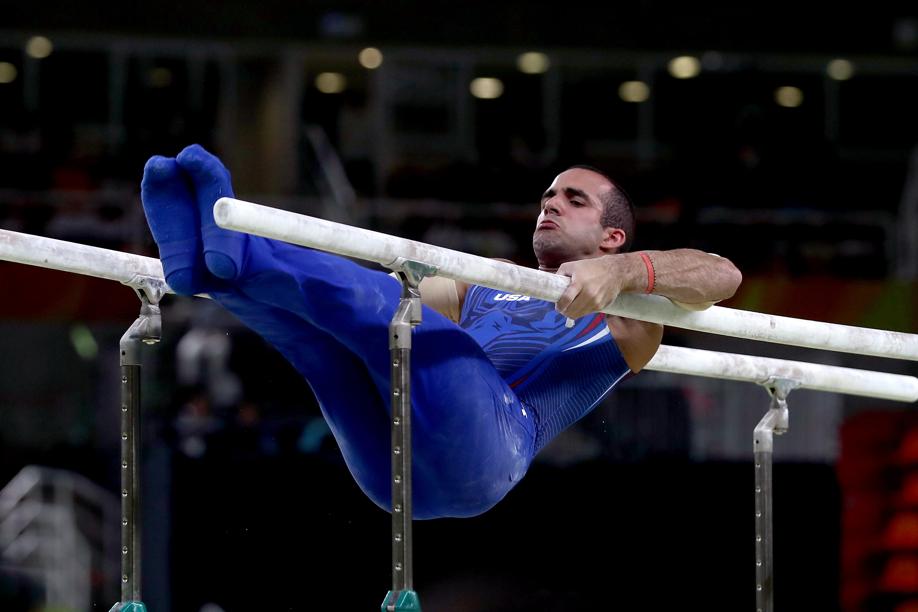
Danell Leyva wasn’t even supposed to be competing in the Olympic Games in Rio de Janeiro.
A dog bite to his leg slowed his preparations this spring and he was relegated to alternate status when the US men’s Olympic gymnastics team was announced in late June. He wasn’t added to the five-man squad until John Orozco injured his left knee a month ago.
On Tuesday, Leyva made the most of his second chance, winning silver medals in both the parallel and high bars.
Germany’s Fabian Hambuechen came away with the gold in the high bar to add to the silver he won in London and the bronze he captured in Beijing in 2008.
Hambuechen posted a score of 15.766, just ahead Leyva, who had won his first silver just 90 minutes earlier on the parallel bars, won by Oleg Verniaiev of Ukraine.
‘‘Nobody has a perfect day, but I feel like this was as close to perfect as I could possibly have done,’’ Leyva said. ‘‘I'm incredibly happy.’’
Leyva was thrilled to have navigated through his many obstacles to win two medals. However, there was one person that was probably just a bit more jazzed about his triumph.
His stepfather and coach Yin Alvarez ran around jumping and screaming after both of his performances.
‘‘No matter what I do Yin is always more excited,’’ Leyva said.
Alvarez maintained that energy long after the final medal ceremony. He bounded through the mixed zone high-fiving people and sporting a huge grin.
‘‘I always say any medal, any color is good,’’ Alvarez said. ‘‘So two silver medals in one competition in the same day is amazing.’’
Leyva, who won a bronze medal in the all-around competition in London, went first on the parallel bars on Tuesday. He pulled off a nearly flawless routine, and when he stuck the landing without so much as a hop he knew he'd be on the medal stand. He was even more confident after seeing his score of 15.900. But that didn’t make the long wait for the final results any easier.
‘‘It was a little stressful waiting for all the scores,’’ he said.
He wasn’t able to let up and fully soak in the moment after he won his first medal with only about an hour until he'd take on the high bars. He even issued a silent warning the apparatus as he was receiving his first medal of the day.
‘‘Even when I was on the podium I was looking over at the high bar and I was like: ‘I'm going to get you now, boy,'’’ he said.
Leyva fell on high bar during the team competition a week ago as the Americans finished a disappointing fifth. Even though they were too far back for his late fall to have mattered much in the standings, Leyva was hard on himself about the miscue and was relieved to stick his routine in the event finals.
‘‘This was absolutely redemption, not only for me but for the team as well,’’ he said.
He went last on the high bars, and his score of 15.500 knocked teammate Sam Mikulak out of a bronze medal and into fourth place. Leyva’s big day gave the Americans three medals in men’s gymnastics after Alex Naddour won bronze in the pommel horse.
Leyva’s work not only allowed him to bounce back after his tough day in team competition, it was validation for the 24-year-old.
‘‘Things didn’t happen the way I expected, and it was unfortunate the way I was named onto this team,’’ he said. ‘‘But that’s what this medal is for — to show that I deserved to be on that team just as much as John did. And this is for him just as much as it’s for me.’’
Boxing — Robson Conceicao won Brazil’s first Olympic boxing gold medal, dazzling the roaring, dancing, chanting fans who packed the 9,000-seat arena with a unanimous decison over Frenchman Sofiane Oumiha in the lightweight bout.
The Brazilian fans counted down the final seconds and waved their flags in celebration when it was over. When Conceicao had his hand raised, he dropped to his knees as the crowd absolutely erupted and shook the bleachers.
Conceicao stood on the ropes of two corners, pumped his fists and saluted the fans. He swept the scorecards 30-27, 29-28 and 29-28.
Mongolian Otgondalai Dorjnyambuu and Cuban Lazaro Alvarez won bronze.
Men’s weightlifting — Lasha Talakhadze of Georgia set a world record in the over-105 kilogram division with 473 total kilos to win the gold medal in an upset over the heavily favored Behdad Salimi of Iran.
The 22-year-old Talakhadze lifted 215 kilos on the snatch and 258 on the clean and jerk to set the new mark.
Salimi set the world record for the snatch with 216 kilos. But he could not complete any of his three attempts on the clean and jerk. Salimi appeared to disagree with the judges’ ruling on his first two tries and didn’t have the energy to complete the third.
Gor Minasyan of Armenia won silver and Georgia’s Irakli Turmanidze took home the bronze.
Cycling — Jason Kenny capped another dynamic performance for Britain with the gold medal in the keirin, his third at Rio and the sixth for his powerhouse program.
Dutch rider Matthijs Buchli took silver and Malaysia’s Azizulhasni Awang took bronze.
Kenny nearly was disqualified when he joined Awang in sprinting too early along the backstretch. The race was halted as jurors reviewed film and ultimately decided on a full-field restart.
The race was halted again on the second try when Germany’s Joachim Eilers sprinted early.
Laura Trott continued Britain’s golden Olympics by defending her title in the women’s omnium, adding to the gold medal she won in the team pursuit competition.
Sarah Hammer of the United States took silver ahead of Belgium’s Jolien D'Hoore.
Trott had three victories and two second-place finishes in the first five races of the six-discipline omnium, then merely padded her lead in the points race to easily secure victory.
The British team has won five of the eight gold medals available in the track program. Jason Kenny in the keirin and Becky James in the individual sprint can add to that total.
Kristina Vogel of Germany swept past Becky James of Britain to win the gold medal in the individual sprint.
Katy Marchant added a bronze for Britain when she swept Elis Ligtlee of the Netherlands.
The world bronze medalist in the event, Vogel knocked off Marchant in the semifinal round to set up her match with James. She won both races in the best-of-three event from the lead, even losing her saddle as she crossed the finish line to win the gold medal.
Greco-Roman wrestling — Top-ranked Artur Aleksanyan of Armenia easily won the gold medal at 98 kilograms.
Aleksanyan beat Cuban Yasmany Lugo Cabrera, 3-0, halting Cuba’s attempt to win an Olympic title in each day of the Greco-Roman portion of the tournament.
Aleksanyan scored early with a two-point turn and deftly defended himself in the second period to clinch his third straight world title.
Bronze medals went to Turkey’s Celk Ildem — who did a backflip to celebrate his win — and Iran’s Ghasem Rezaei.
Davor Stefanek became the first Serbian man to win an Olympic gold medal, taking the title at 66 kilograms.
Stefanek, who upset top-seeded German Frank Staebler in the quarterfinals, beat Armenia’s Migran Arutyunyan, 1-1, on criteria. Stefanek scored the final point to clinch the match.
Georgia’s Shmagi Bolkvadze and Rasul Chunayev of Azerbaijan won bronze.
Women’s table tennis — China defeated Germany to win the team gold medal, keeping pace at the Rio Games to repeat its London sweep.
The three-member Chinese team, which lost only a single game, consists of the gold and silver medalists from Rio and the No. 1 player in the world.
The Japanese women took team bronze over Singapore.
China’s men’s team plays Japan on Wednesday for gold. A win would see China again taking all the table tennis gold, in singles for men and women and in both team competitions.
Sailing — Cancer survivor and six-time Olympian Santiago Lange of Argentina won the gold medal in the Nacra 17 mixed catamaran with crew Cecilia Carranza Saroli.
Lange lost part of a lung to cancer last year.
It’s been an extraordinary games for the 54-year-old Lange. He is the oldest competitor in sailing at Rio and his sons, Yago and Klaus, are sailing for Argentina in the 49er skiff class.
He and Saroli won the gold by one point over Jason Waterhouse and Lisa Darmanin of Australia. Thomas Zajac and Tanja Frank of Austria won the bronze.
He and crewmate Carlos Espinola won bronze medals in the discontinued Tornado class at Athens in 2004 and Beijing in 2008.
New Zealand’s Peter Burling and Blair Tuke won the gold medal in the men’s 49er class with a race to spare. The Kiwis came in as the overwhelming favorites after dominating the skiff class the last four years after taking the silver in London.
They've dominated in this regatta, too. They finished third, fifth and fourth in Tuesday’s races to take an unassailable 34-point lead over Germany’s Erik Heil and Thomas Ploessel. Defending gold medalists Nathan Outteridge and Iain Jensen of Australia are in third place going into Thursday’s medal race.
Burling and Tuke also sail for Emirates Team New Zealand in the America’s Cup. Outteridge and Jensen sail with Sweden’s Artemis Racing.
Tom Burton of Australia won gold in the Laser class. It’s the first sailing gold in Rio for the Australians, who won three classes in London in 2012.
Burton finished 2 points ahead of Tonci Stipanovic of Croatia, who came in already having been assured of at least the silver. His silver is Croatia’s first Olympic sailing medal.
Sam Meech of New Zealand won the bronze.
Robert Scheidt fell just short in his attempt to become the first sailor and first Brazilian to win six Olympic medals. Although he won the medal race, he finished fourth overall, 4 points behind Meech.
Hannah Mills and Saskia Clark of Britain won the women’s 470 gold medal with the medal race to spare.
The British team, who took silver four years ago at London 2012, had solid scores of 3-2-3 Tuesday to carry an unassailable 20-point lead into Wednesday’s medal race. The only thing that stands in the Brits’ way is if they receive a technical two-point penalty for failing to follow pre-medal race procedures.
Their rivals, defending Olympic champions Jo Aleh and Polly Powrie of New Zealand, have sailed an incredible comeback series after two costly disqualifications earlier in the regatta. The Kiwis’ scores of 1-1-4 Tuesday have lifted them back to the silver medal position. There are six teams in contention for silver and bronze, including the United States.
Swimming — Russia continued its dominance of Olympic synchronized swimming in the duet as Natalia Ishchenko and Svetlana Romashina each won their fourth career gold medals.
Russia has won every available Olympic gold in synchronized swimming since 2000, and Ishchenko and Romashina are among the most decorated swimmers in the sport’s history.
They performed an elegant and up-tempo free routine to win gold with a total score of 194.991 out of a possible 200, after coming in with the lead from the technical routine, and embraced their coaches at poolside.
That made it almost impossible for China’s Huang Xuechen and Sun Wenyan to challenge, and they had to settle for their country’s first Olympic silver in synchro duet on 192.3688.
Japan edged out Ukraine for bronze on 188.0547.
Men’s diving — China was atop the podium in diving again, with Cao Yuan winning the 3-meter springboard for his country’s fifth gold on the boards.
Cao led throughout the six-round final, totaling 547.60 points. It was his second medal at the Rio Games, having earned bronze in men’s synchronized 3-meter.
Jack Laugher of Britain took silver at 523.85, the nation’s first Olympic medal in the event. He gave the country its first diving gold when he and Chris Mears won synchronized springboard in Rio. That’s the only event so far that has eluded the Chinese.
Patrick Hausding of Germany earned bronze at 498.50.
 PREVIOUS ARTICLE