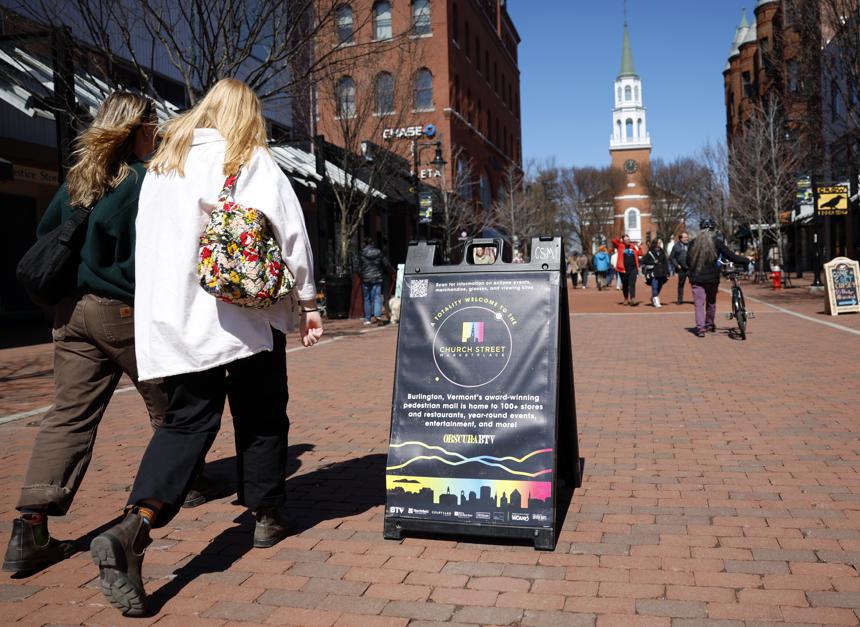


BURLINGTON, Vt. — Near the start of the summer tourism season, Mayor Emma Mulvaney-Stanak convened a press conference along an outdoor pedestrian shopping mall to make a bold declaration: “Burlington is back.’’
For years, this city on Lake Champlain had been hobbled by the perception its downtown was no longer safe. Increases in crime, open-air drug use, and public homelessness had scared off suburban shoppers, and seemingly endless roadwork and construction had further diminished its appeal.
But, the mayor said, standing outside a home goods store, “There’s a growing sense that Burlington is turning a corner, that energy is back, the confidence is returning in the city, and that this city is moving forward.’’
Whether that is indeed the case has become a central question in one of Vermont’s most closely watched political races ahead of its primary on Tuesday — for the top prosecutor of the county with the state’s largest city. The corollary is: If Burlington
A series of recent events has brought those questions into sharper relief in the homestretch of George’s reelection campaign: Last week, Vermont’s Republican governor, Phil Scott, deployed the State Police to patrol Burlington’s downtown for the second time in a year — at the behest of community members, he said, and without much notice to the city.
This week, the Burlington City Council advanced a resolution criticizing the mayor’s attempts to revive the downtown and outlining a more aggressive approach to combating crime and public drug use. During three hours of public comment on the matter, some expressed exasperation with the state of the city, while others described the resolution as a draconian response that would penalize the most vulnerable members of society.
Meanwhile, a local funeral home owner penned an open letter describing a situation in which the family of a deceased teenager had to consider “which downtown church would require hundreds of children attending her funeral to walk past the fewest encampments, the least amount of drug use, and the fewest public safety concerns.’’
And The Atlantic published a provocative story by former Burlington Free Press reporter Michael Powell arguing that permissive “harm reduction’’ policies in Burlington, Seattle, and Vancouver had ravaged all three cities.
Since March, when Bram Kranichfeld entered the race for county prosecutor, he’s advanced a similar narrative about Burlington — and laid the blame at the feet of his opponent, George, a fellow Democrat who’s held the office for nearly a decade.
“I’ve spoken to countless people who do not feel as safe as they did nine years ago and who absolutely think that public safety is a priority issue,’’ he said, describing a “general sense of lawlessness and frustration’’ in downtown Burlington stemming from “unchecked criminal behavior.’’
George, on the other hand, maintains her policies are slowly chipping away at problems that are well beyond her control — a fentanyl epidemic, a homelessness crisis, and a global pandemic that closed Vermont’s courts, exacerbating backlogs in the criminal justice system.
Kranichfeld, she contends, is peddling “false promises’’ and unfairly blaming her for the city’s woes.
“Giving people the idea that it is one person’s fault is very harmful and disingenuous and irresponsible,’’ she said.
The two candidates have plenty in common. George, 43, and Kranichfeld, 46, worked together as deputies in the Chittenden County State’s Attorney’s Office until their boss resigned and Scott appointed George over Kranichfeld to finish the term. (He later said he regretted the choice, disagreeing with her progressive policies.)
George has been reelected twice since, including in a similar race four years ago, when she handily defeated another law-and-order challenger.
Kranichfeld’s career has taken a more circuitous path. He left the criminal justice system for the priesthood, only to return when Scott appointed him to another vacant county prosecutor’s office. Now he’s hoping to return to his home county of Chittenden, which hosts about one-quarter of the state’s population and many of its largest towns and cities.
The race has turned on a couple of key policy differences: George has refused to seek cash bail for those charged with crimes and won’t take cases stemming from low-level traffic stops; she argues both practices punish the poor and people of color. Kranichfeld says he’d restore both policies in order to use “all the tools available as prosecutors.’’
But more than policy, the campaign has centered around perception. And everybody in town seems to have a different one about how safe Burlington is.
Mark Bouchett, who hosted the mayor’s press conference outside his Homeport store, said he’d been happy to celebrate the city’s progress — particularly after a long-awaited hotel and apartment tower replaced a desolate downtown block universally known as “the pit.’’
“If you’re a shopper down here, you’re safe. If you’re coming to a restaurant, you’re safe,’’ said Bouchett, who also chairs the Church Street Marketplace Commission.
At the same time, he noted, nearby City Hall Park remains inundated with those experiencing homelessness, mental health challenges, and substance use disorder.
“You’ll see people doing drugs, which you never would have seen seven years ago. And that’s scary to look at, but it’s not threatening to you,’’ he said.
City Council President Ben Traverse, a Democrat who sponsored this week’s public safety resolution, has a darker view. When he leaves City Hall late at night, he said, he does not feel comfortable walking home.
“It’s not good,’’ he said. “I’m a big guy, but I don’t feel safe walking through the park at that hour.’’
Burlington’s police force remains understaffed, Traverse said, as it has been since the city capped the number of officers at the height of the Defund the Police movement in 2020 — a policy it later rescinded.
As for Mulvaney-Stanak’s declaration Burlington is back?
“The first thought that came to my mind was George W. Bush’s ‘mission accomplished’ moment,’’ Traverse said, referring to the then-president’s victory speech on an aircraft carrier six weeks into the nine-year Iraq War.
Traverse has endorsed Kranichfeld, largely because he believes George has presided over a period of failure.
“I don’t think any single person is to blame for our community’s public safety challenges, but if anyone’s going to be held accountable, I think it should be our county’s chief law enforcement officer,’’ he said.
Jason Van Driesche, a former City Council candidate who has endorsed George, sees it differently.
“It’s not like the rest of the world is rosy and Burlington is going to hell in a handbasket,’’ he said. “These are broadly shared problems, and we have our own particular flavor of them. I think Sarah is doing a credible job of solving those problems.’’
During a press briefing Wednesday at City Hall, Mulvaney-Stanak, George, and other city officials summoned reams of data to push back on the unrelentingly negative narrative. Homicides, aggravated assaults, and other violent crimes are down significantly from pandemic-era highs, they noted, and fatal overdoses have also dropped, mirroring national trends.
Many of the remaining problems are caused by just a small group of people — 56 to be exact, according to interim Police Chief Shawn Burke. And two-thirds of them are experiencing homelessness. A new “accountability court’’ created by Scott’s administration and continued by George has been providing resources to — and consequences for — many of those people and is successfully clearing out COVID-era court backlogs, George said.
In an interview that day in City Hall Park, where some denizens appeared to be using or selling drugs, George said she was “cautiously optimistic’’ Burlington was on the right path. She also expressed frustration at being blamed for challenges outside any prosecutor’s control, such as poverty and homelessness.
Where does that blame come from? “I think the second that I was labeled a ‘progressive prosecutor’ and the second that I started talking about the legal system in a really honest and brutal way, it put a target on my back to blame me for things,’’ she said.
The news media has further fanned the flames, she said, by writing about a crime of some notoriety, but failing to cover when she successfully convicts the perpetrator. And sexism has also contributed, she said with some reluctance, noting that “it never goes over well when women say that sex plays a part.’’
Though George’s reelection race is a somewhat local affair, it has drawn attention from the halls of power in Montpelier.
At an unrelated press conference Thursday, Scott encouraged voters of all stripes in Chittenden County to cast ballots in the Democratic Party primary in order to influence the outcome of the race for prosecutor. He noted that, because no Republicans are seeking the seat, Tuesday’s winner will almost certainly prevail in November. (Voters don’t register by party in Vermont and can cast a ballot in any primary.)
Scott is also running for reelection but does not face a challenger in the Republican primary. When pressed, he said he would vote for Kranichfeld if he lived in Chittenden County.
“I think there are two clear choices here,’’ he said.