

America fired Donald Trump in 2020.
Now he’s asking for the job back, and fundamental to his pitch is that the economy was much stronger when he was president than it has been under Joe Biden.
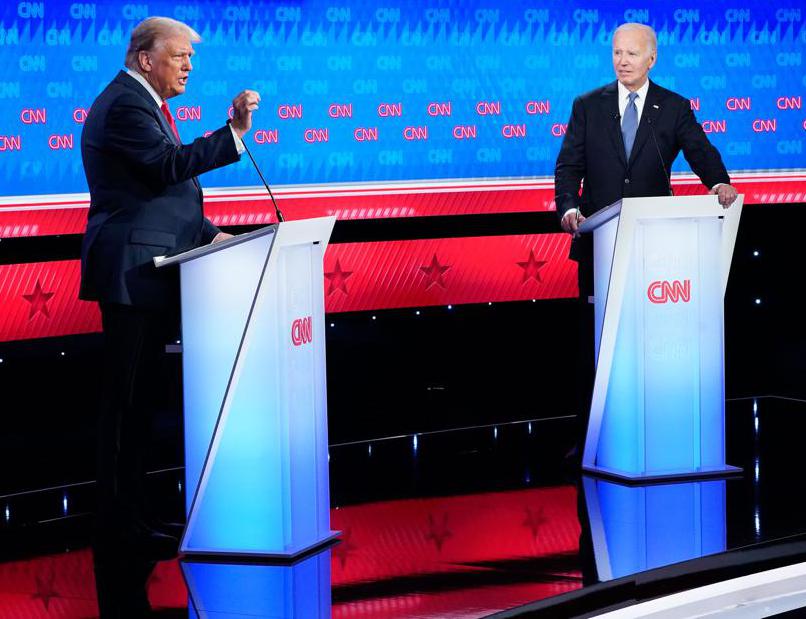
“We had the greatest economy in the history of our country,’’ Trump said last month in his debate with Biden. “We had never done so well.’’
Not true.
A review of the facts might help undecided voters assess whether Trump’s economic record warrants a second chance regardless of whether Biden stays in the race.
While tax, spending, and other government policies are important, US business cycles are driven by forces — such as interest rates, global trade, technology, geopolitical events — that are largely beyond the White House’s control.
ª Comparing the Trump and Biden economies is especially hard because of the massive disruptions caused by COVID.
ª Focusing on Trump’s first three years in office (2017-2019), before the pandemic’s onset in March 2020, makes for cleaner comparisons. So does excluding 2021’s unprecedented rebound from Biden’s record.
ª Trump’s record versus Barack Obama’s second term is in many ways just as relevant.
ª During Obama’s second term, gross domestic product, the broadest measure of economic growth, expanded at an average annualized rate of 2.5 percent a quarter. That was up from an average of 1.5 percent in his first term, which began during the Great Recession.
ª Unemployment, which hit 10 percent in the fallout from the recession, was 4.7 percent when Obama left office, roughly the same as before the financial crisis.
ª The jobless rate fell to 3.5 percent at the end of 2019, the lowest since the late 1960s.
But as The New York Times reported earlier this year, the study showed that investment and income gains were smaller than predicted by Republicans and the tax package failed to pay for itself as they promised, adding to the federal deficit.
ª Mexico surpassed China as the leading supplier of US imports after Trump raised tariffs on Chinese goods.
ª American farmers were hit hard by China’s retaliatory tariffs on US agricultural goods, though Trump sought to mitigate the impact with $23.6 billion in direct farm aid in 2019, more than double two years earlier.
ª Quarterly GDP growth averaged 5.4 percent in 2021.
ª Unemployment was 4.1 percent last month, down from 6.4 percent when Biden took office. It fell to 3.4 percent earlier in his term.
ª The consensus among economists is that pandemic-related factors were largely responsible for driving costs higher, including supply constraints, a shortage of workers, and shifts in consumer spending patterns. Heavy stimulus spending under Biden was a secondary cause.
ª US production of oil and gas set records in 2023.
ª Federal onshore drilling permit approvals rose under Biden.
ª Trump emphasized cutting taxes and regulations, which mostly helped businesses and the wealthy, and promises more of the same if reelected.
ª Biden has focused on investments in infrastructure, clean energy, and critical technologies such as advanced semiconductors, and vows to raise taxes on the wealthy to support low- and middle-income families if he wins another term.
Trump’s economic successes are exaggerated. So are Biden’s failures.