

For those who run the Boston Marathon or hope to run it, and for the hundreds of thousands who line its route, cheering the runners, Monday is as close as the secular world gets to a holy day of obligation.
In its 127-year history, the Boston Marathon has grown from amateur footrace to one that this year will host some 30,000 runners from around the world, including some of the finest and fastest on the planet.
Boston has always taken a certain pride in its role as host, the finish line across Boylston Street never allowed to fade before it is once again refurbished — a continuing reminder of its storied history.
And yet that same finish line is also a reminder of the tragedy that took place 10 years ago — the lives lost, the hundreds of lives changed forever by catastrophic injuries, the thousands of lives touched when this center of civic pride and celebration became a crime scene.
It’s not that the events of April 15, 2013, with all its trauma and all its heroism, have been forgotten in the intervening years. But 10 years is one of those markers that cries out to be observed — a moment in time that demands we look back and remember and look ahead too to see what we as a community have learned and have given back over that time.
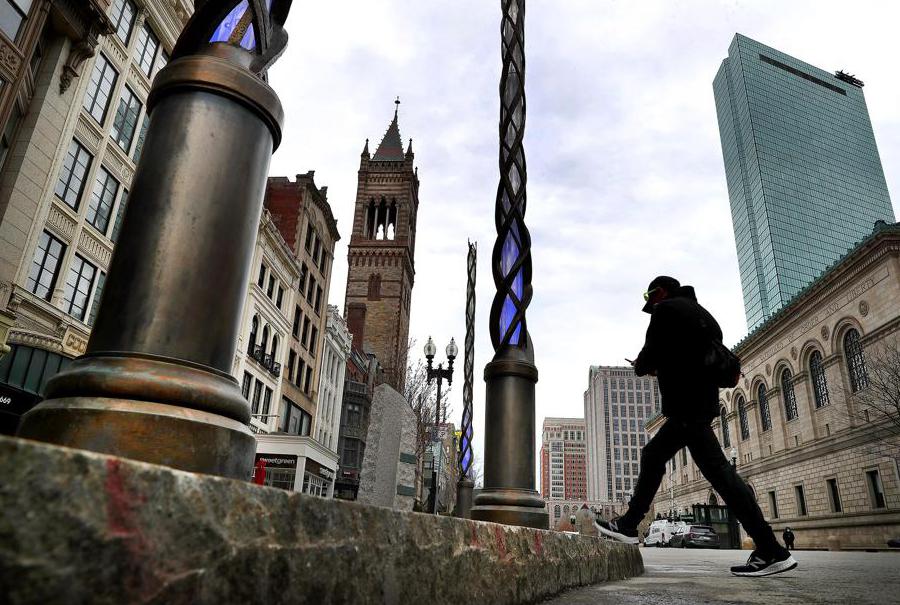
Today two memorials, a block apart on Boylston Street, mark the spots where the two bombs went off. The four granite pillars ringed by bronze and glass spires honor the lives taken on that day — 8-year-old Martin Richard of Dorchester; Lingzi Lu, 23, a Boston University graduate student from China; and Krystle Campbell, 29, a former University of Massachusetts Boston student and restaurant manager from Medford.
The memorial also includes the names of MIT Police Officer Sean Collier, who died after being ambushed by the two bombers on April 18, and Boston Police Officer Dennis Simmonds, who died a year after sustaining injuries during the Watertown shootout in which the sole remaining bomber was captured.
But the memorials aren’t the only remembrances. There are the daffodils, pots and pots of them in the early years after the bombing, intended to renew the spirit, now replanted around the city, giving back every year.
And for weeks leading up to the Marathon, Boston is awash in yellow and blue — the colors of the Boston Athletic Association — that in the days following the bombing morphed into the colors of Boston Strong, which on T-shirts and hats became a community’s mantra and its hope.
“Our faith in each other, our love for each other, our love for country, our common creed that cuts across whatever superficial differences there may be, that is our power. That’s our strength,’’ President Barack Obama told the community at an interfaith service three days after the bombing. “That’s why a bomb can’t beat us. That’s why we don’t hunker down. That’s why we don’t cower in fear.’’
Many of the survivors of that day became living, breathing examples of that creed.
■ People like Adrienne Haslet, a ballroom dancer who lost a third of her left leg and went on to run marathons and become a key advocate for adding a para-athlete division to the Boston Marathon.
■ Heather Abbott, a Rhode Island native, who lost a leg on that day but went on to start the Heather Abbott Foundation to help other amputees be able to afford the costly prostheses insurance often doesn’t cover. Dozens of others have been helped through her work.
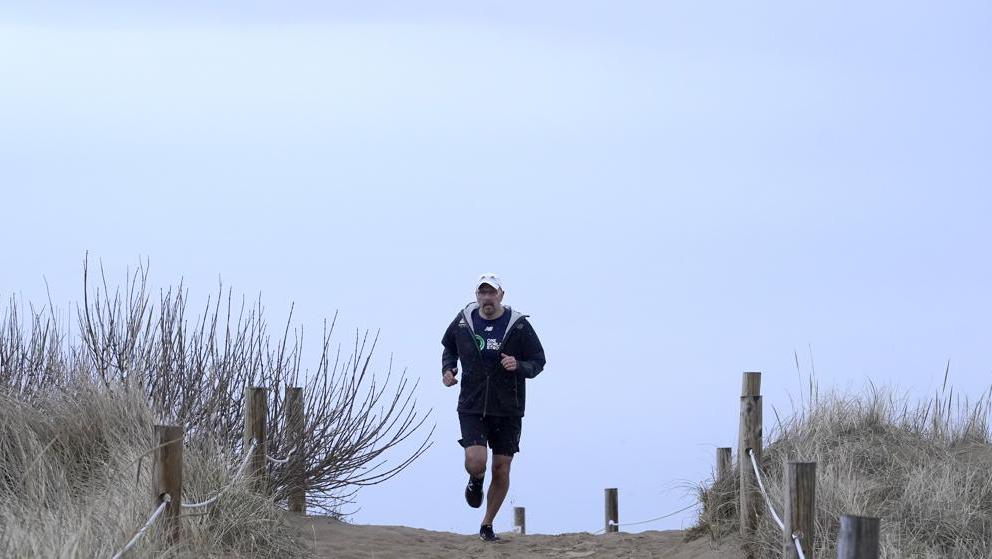
■ Dave Fortier was approaching the Marathon finish line when he felt the blast and the shrapnel, suffering a concussion in the process. He went on to found the nonprofit One World Strong Foundation, gathering other bombing survivors in a network that supports other survivors of violent extremism like the survivors of the Pulse nightclub shooting in Orlando.
■ Jeff Baumann, his legs shattered by one of the bombs, became the face of the tragedy as he was photographed being wheeled away from the scene. He would provide valuable help to the FBI in identifying one of the bombers. He would also write a book about the days that followed, “Stronger,’’ that would be made into a movie. And he would discover the joys of sled hockey and become an inspiration to other amputees.
They are just a handful of the hundreds who redefined resilience as they grappled with their recoveries from wounds seen and unseen, whose lives were altered but not destroyed, who went through the worst day of their lives and carried on.
Today this community is also better and stronger for the experience — for the day that no one would want to relive.
That every victim who made it to a hospital that day — some 280 people — survived was hailed as something of a Boston miracle. What it was was a miracle of brilliant planning and execution in a crisis.
“Adequate preparation, rapid logistical response, short transport times, immediate access to operating rooms, methodical multidisciplinary care delivery, and good fortune contributed to excellent outcomes,’’ is the way one report to the National Institutes of Health put it. Boston’s response could provide a “template’’ for dealing with similar crises, the report suggested.
Boston also became a model for charitable giving and for the rapid distribution of funds to aid victims of the bombing so they could get on with their recovery. What became the One Fund Boston was set up within 24 hours of the bombing as an entirely new entity with a clear purpose. Some 75 days later its first disbursement of $61 million was in the hands of survivors and the families of the victims, wrote Mitchell Weiss, who served at the time as chief of staff to Mayor Tom Menino. Ken Feinberg, who had already led the fund distribution efforts after the Sept. 11, 2001, bombings and the Aurora, Colo., shootings, was called in to head the One Fund effort.
That effort too has become a model for doing things right — hard things, vital things.
“Even when our heart aches, we summon the strength that maybe we didn’t even know we had. We finish the race,’’ Obama said on that day in April when the wounds were fresh, the pain still raw.
Boston did that — it summoned the courage and finished the race. And in doing so provided that template for resilience and for helping each other that this community should never forget.