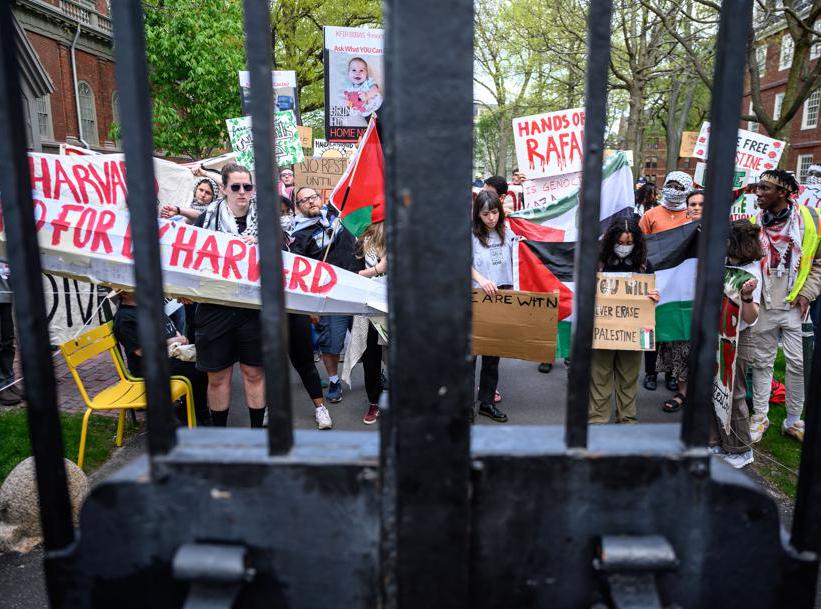


Last year, a number of prominent donors lashed out at Harvard University for its handling of reactions on campus to the Oct. 7 Hamas-led attacks on Israel. Some announced they would freeze donations until the university cracked down on student protesters, did more to combat antisemitism, and reduced its focus on diversity.
Harvard has made some changes since then, but the donors are not done: Two of the most outspoken, billionaire hedge fund manager Bill Ackman and former Facebook executive Sam Lessin, are ratcheting up their campaign to reshape the university, each arguing Harvard is home to too much activism, that the university is lacking viewpoint diversity, and its bureaucracy has become bloated.
Lessin’s and Ackman’s efforts raise questions about the influence big donors have on higher education, long a subject of debate and tension for colleges that rely on philanthropy to fund parts of their operations, including financial aid and athletic programs.
Both men are circulating slide decks among wealthy alumni and top administrators, listing changes they think should be made, and urging donors, who Lessin said in a 97-page slide deck have been “too blindly supportive and trusting,’’ to use their leverage.
“Politicization Is the fundamental problem at Harvard,’’ Lessin wrote in his document. “Valuing certain voices over others based on identity vs. academics, politically prioritizing inquiry, limiting open debate, etc.’’ Lessin was a classmate of Mark Zuckerberg, and had the Facebook cofounder’s support when he unsuccessfully ran for a seat on Harvard’s Board of Overseers last spring.
Separately, Ackman presented a financial analysis of the university to roughly 250 investors at a conference in Manhattan on Oct. 1.
“What Harvard reminds me of is the old days of shareholder activism where you had this impenetrable governance. . . great businesses that have lost their way,’’ Ackman said to the investors in a video recording of the event reviewed by the Globe.
“Is Harvard a Buy, Sell, or Hold?’’ Ackman wrote in the accompanying slide deck. It is a “hold,’’ he said, citing “subpar education’’ and poor management of its endowment, while crediting the university’s powerful brand name, alumni base, and extensive real estate holdings. Ackman added he believes “shareholder activism,’’ or donors pressuring the university to change, is the best hope for Harvard.
A spokesperson for Harvard declined to comment on either presentation.
But Harvard has acknowledged it has work to do to ensure people from all backgrounds feel they can express themselves on campus without self-censoring. The university also formed committees last winter to address antisemitism, Islamophobia, and other forms of hate on campus.
“These are societywide issues,’’ Tomiko Brown-Nagin, dean of the Harvard Radcliffe Institute and cochair of the Open Inquiry and Constructive Dialogue working group, said in a recent interview. “We hope we’ll have the opportunity to show that we’ve been able to make some headway on these issues in the years to come.’’
Some fear these outspoken alumni could undermine years of efforts to make the nation’s oldest college more diverse and accessible in the wake of the Supreme Court decision to end affirmative action in college admissions. Others say their critiques of Harvard are off-base.
There should be a firewall separating donors and politicians from decision-making about university operations to protect academic freedom, said Risa Lieberwitz, former general counsel of the American Association of University Professors in Washington, D.C., and a professor at Cornell University in New York.
“This is a very big concern,’’ Lieberwitz said. “It’s always been an issue, but it’s absolutely getting worse right now because of the debates and protests internally and pressure from outside becoming more pronounced, more public, and more explicit about what universities should do. That attempted interference is completely inappropriate.’’
The presentations from Lessin and Ackman have reached thousands of Harvard alumni as well as key decision makers at the university. Ackman shared his slide deck on social media to his more than 1.4 million followers on X, formerly Twitter.
In September, Seth Klarman, chief executive of the hedge fund firm Baupost Group, forwarded Lessin’s slide deck to Harvard President Alan Garber; Penny Pritzker, senior fellow of the Harvard Corporation; and two other members of the school’s top governing board. A copy of the email was obtained by the Globe.
“Making sure you saw this,’’ Klarman wrote. “It’s going around.’’
A Baupost spokesperson declined to comment. Klarman, for whom a hall at Harvard Business School is named, did not respond to the Globe’s emails.
Ackman, who holds an MBA from Harvard Business School and a bachelor of arts from Harvard College, was among the school’s loudest critics during last year’s student protests over the Israel-Hamas war, calling on university leaders to release the names of students affiliated with a controversial statement blaming Israel for the violence. He was among the first prominent voices to raise concerns about rising antisemitism on campus, and also to call for then-President Claudine Gay to resign after her disastrous testimony before a congressional hearing about the campus environment last December.
In a statement, Brian Lee, Harvard’s vice president for alumni affairs and development, said that philanthropy enables the university “to do extraordinary things.’’
“It funds the scholarship and research of our outstanding faculty, and helps us to assemble the most talented students across our undergraduate and graduate programs,’’ Lee said. “This work would be unimaginable without the support of the alumni.’’
Meanwhile, Larry Ladd, a higher education consultant and former director of budget and financial planning at Harvard, said some of Ackman’s analysis is misleading.
Ackman, for example, highlights the growing sticker price of a Harvard education in recent decades, which today is more than $87,000 a year for tuition, fees, room, board, books, and travel. While true, higher education watchers say it does not show the full picture: A quarter of Harvard undergraduates pay nothing to attend and more than half receive financial aid.
“Harvard is not as simple as a business,’’ Ladd said. “No university is as simple as a business. And data that comes out of universities, including Harvard, is rarely as simple as it appears.’’
Ackman criticized Harvard for not generating “positive cash flow,’’ adding that it is dependent on distributions from its endowment, a common practice for the nation’s wealthiest schools. Ackman also said its $51 billion endowment has underperformed in recent years compared to Ivy League peers, a sign to him the school has lost its way.
Ladd said that unlike most colleges, demand for what Harvard is offering is not a concern, with huge numbers of students continuing to apply every year.
The credit rating agency S&P judged Harvard’s financial management to be sound, assigning its highest bond rating of AAA to the university earlier this year, noting its “exceptional financial resources,’’ “robust demand for academic programs,’’ and “very strong fundraising ability.’’
Also in his presentation, Ackman took issue with the current mission statement of Harvard College, which includes phrases such as “diverse learning environment’’ and “exposure to new ideas.’’ The previous mission statement encouraged “students to respect ideas and their free expression, and to rejoice in discovery and in critical thought; to pursue excellence in a spirit of productive cooperation; and to assume responsibility for the consequences of personal actions.’’
Other alumni have also criticized the change. “What I take from that is Harvard is embracing activism rather than academic integrity,’’ said Roni Brunn, a spokesperson for the Harvard Jewish Alumni Alliance.
Harry Lewis, a former dean of the undergraduate college and a computer science professor, said he wrote the first-ever mission statement for Harvard College in the late 1990s when the National Collegiate Athletic Association insisted the school needed a mission statement in order for its athletic programs to be reaccredited.
Lewis said he is not a fan of the updated mission statement, adding it “seems to revolve around a different set of values.’’
Lessin said in an interview that Harvard should consider shedding its Divinity School, which enrolls about 320 students. Last spring, the Divinity School’s student association passed a resolution calling on the university to divest from companies tied to Israel.
“We have a school, which has really changed in its mission and how it’s operating on campus,’’ Lessin said. “It no longer is highly aligned with the rest of the university. Why not consider divesting from them?’’
Lessin also wrote that 5 percent to 10 percent of Harvard students “are a real problem,’’ referring to activists. He said Harvard should seek other kinds of diversity beyond racial and ethnic, including recruiting from red states. He also questioned whether Harvard should continue with the tenure system.
Out of his failed write-in campaign for the Board of Overseers, Lessin launched a weekly email newsletter for concerned Harvard alums, the 1636 Forum, which he said has 20,000 subscribers. The group is sharing materials they call a “guide to giving’’ with alumni who want to make their donations conditional.
Lessin said he is considering another run for Overseers in 2025. Both Lessin and Ackman have expressed frustration that Harvard makes it difficult for outside candidates to lobby for a seat on the Board of Overseers, made up of 30 alumni elected each spring by Harvard graduates.
Lessin said he has seen Ackman’s presentation and agrees with much of it, but said he is not working with Ackman.
Both men, however, point to a startup university as a model for Harvard to emulate. The University of Austin, also known as UATX, was founded in 2021 to counter what prominent backers, including journalist Bari Weiss and Joe Lonsdale, cofounder of Palantir Technologies, viewed as problems at many US universities, including professors and students self-censoring.
Lessin is a donor, and Ackman has praised the effort, saying in his recent presentation the venture is “going back to a classical education.’’
Ackman takes particular aim in his presentation at Harvard’s Department of African and African American Studies, saying an imbalance between the number of majors and professors shows that Harvard does not allocate resources efficiently.
Most professors in the department hold joint appointments in other areas of the university, according to Harvard. Tommie Shelby, a Harvard professor of philosophy and of African and African American studies, said the department was designed that way “so that the kind of work that we do shows up in all the relevant departments and schools at the university.’’
Shelby added he views Ackman’s presentation as an “attack on Harvard’’ in line with broader skepticism about diversity, equity, and inclusion programs.
“We’re here to produce and disseminate knowledge and to meet the highest scholarly standards of our field,’’ Shelby said. “These attacks are exploiting a prejudice against the field that suggests it’s not serious scholarship.’’