

It’s a dark time in our country. Night in America, we might call it. Every day, one piece of evil or absurd news follows the next: Immigration and Customs Enforcement thugs fulfilling their boss’s orders; the US military killing people in motorboats off the coast of Latin America; vaccines that have saved millions of lives suddenly being considered suspect; pardons given to criminals who should remain behind bars; a president who mocked his predecessor as “Sleepy Joe’’ now falling asleep in Cabinet meetings, the meetings themselves a shameless display of hapless encomium; and heroic Ukrainians being sold down the river to benefit a Russian dictator.
I could go on, but any non-cultist paying the smallest bit of attention has to wonder how an imperfect but great nation could be turned into a fiefdom in one year — how we’ve come to have a czar, supported by oligarchs, instead of a president, masked and armored law enforcement teams who grab people off the street, a pliant Supreme Court, and an impotent Republican Congress.
While all this is going on, the vast majority of us are living our ordinary lives — driving to work, raising our kids, caring for our elders, tending to our health, having a little enjoyment now and again. Our minds are a split-screen: one half struggling to digest indigestible news, the other making sure we stop at red lights, pay our bills, and keep the kitchen clean.
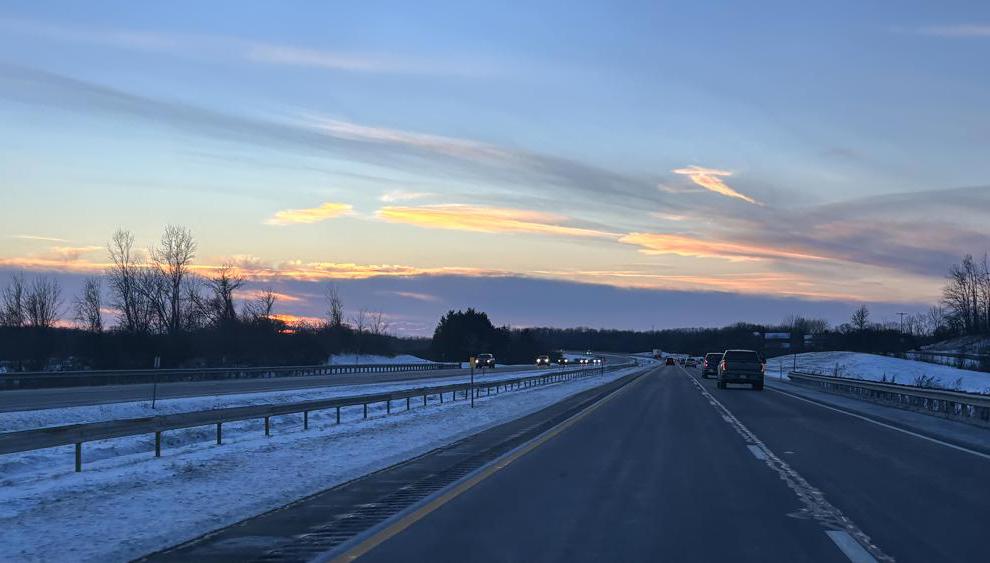
Over the past couple of months, as the darkness deepened, I’d tell my wife, Amanda, that I was thinking about driving across the country, coast to coast. At night.
“Have fun,’’ she said at first. She’s a photographer. The idea of traveling without being able to see anything was — no surprise — unappealing.
But I told her I wanted to make the nighttime drive not just for the fun of driving but in order to write something about this dark American moment. I wanted to bear witness. I wanted to pay attention to the bad news, yes, but also talk with people doing amazing things, and travel to places that had some particular connection to current political events. I told her we could drive only a few hours every evening, stay in hotels, get up the next day and explore, observe, talk, and listen, noting the good as well as the terrible.
I had a list of places I thought would illuminate key issues: immigration, the environment, manufacturing loss, and so on. She could take photos and I could write.We’d leave a record of these awful times and come face to face with an America deeper than the headlines, more complicated, more real.
We’ve been married 46 years, and in that time Amanda has indulged more than one of my eccentric notions, literary and otherwise. We watched the news together one night — more craziness, more evil — and when the broadcast was over, I mentioned the idea again. “Night in America,’’ I said. “It would be a good book title.’’ She started making our reservations.
So far we’ve stopped in five of the roughly 20 cities on my list, so this is a kind of quarterly report, the first of several. Each of these stops — Revere and Pittsfield in Massachusetts; Verona, N.Y.; Erie, Pa.; and Columbus, Ohio — connect in particular ways to the current national scene.
Revere, where I was raised, is America’s immigration central. And immigration is one of the chief issues that got Donald Trump elected. Pittsfield is still reeling from General Electric’s abandonment, and from the legacy of PCB, or polychlorinated biphenyls, pollution the company left behind. Verona, home of the Oneida Nation, was where the Oneida Commune, an experiment in utopian living, thrived for more than three decades in the middle of the 19th century. Erie, first with its shipbuilding and later with its ironworks, paper manufacturing, and GE’s locomotive plant, was a rust-belt bulwark; it now has the highest child poverty rate in Pennsylvania. And Columbus, the site a few years ago of a very small neo-Nazi hate march, is home to the gods of America’s religion: college football.
But those are only labels, only half of the split screen. To talk about cities that way is part of the problem that haunts us every day: We’ve somehow been trained to see our country in broad brushstrokes, to see individual human beings according to their skin color, ethnicity, religion, sexuality, or politics, instead of as unique and sacred souls.
In Revere we spoke to a Colombian immigrant, new to citizenship, who works 100 hours a week and struggles to perfect her English, and a proud Lebanese woman in a bakery. In Pittsfield, I sat down with Al Bertelli, who spent four years in the US Army and 33 years in GE’s enormous factory buildings and now lives a stone’s throw from a branch of the Housatonic River that the company polluted. In Verona, we stayed at the Disney-like Turning Stone resort, run by the Oneida Nation, and spoke with Karen, a member of the Turtle Clan, who was doing traditional beadwork in her shop a few steps from the gleaming slot machines that have made her tribe wealthy.
In Erie, we had delicious $5 bowls of Italian wedding soup at Avanti’s, and Rich Forsgren, a former photojournalist for the Erie Times-News, who grew up in the city and knows it the way Billy Joel knows a piano, gave up half his Saturday to drive us around its neighborhoods. And in Columbus, we watched the Indiana-Ohio State Big Ten championship game in Saturn’s, a sports bar we happened into where just about all the other patrons were Black, and we were treated with a degree of courtesy and hospitality that stood in perfect contrast to the divisive rhetoric of Trump and his white supremacist pals. Outside the bar we had a conversation with one of the security team members, Darrius McLean, who grew up in a house with no hot water, earned a college degree, and aspires to a profession where “I can help people the way I was helped.’’
It’s night in America, sure. The suffering imposed upon the nation — by Trump’s ICE goons, his billionaire buddy with the so-called Department of Government Efficiency cuts, his pliant Congress and captive Supreme Court — is as real as it is immoral. But that’s only half the picture. Trump doesn’t have the soul for it, I know, but I’d love to see him remove the blinders of his ultra-privileged life, just for a week, and pay attention to the other half of the picture, the generosity and decency and grit, the millions of selfless acts, small and large, that bind our diverse communities together.
I’d love to have a president who walked through the streets of Erie’s Lower East Side, who shook hands with the guy working the metal detector at the door of Saturn’s in Columbus, who talked for even a few minutes with Al and Nancy Bertelli in their home near the Housatonic, who complimented Karen’s beadwork, and thanked the Lebanese woman in the Moroccan bakery in Revere when she served him a delicious piece of baklava.
Instead, we have a president dining in his Mar-a-Lago palace, shaking hands with monsters like Vladimir Putin of Russia and Mohammed bin Salman of Saudi Arabia, demolishing part of the White House so he can have more places to decorate with gold, and calling Somalis “garbage,’’ a governor “retarded’’ (a word we teach our kids not to use), and a female reporter “piggy.’’
Impossible as it is to hope for such a thing, I’d love to have Trump and his toadies in Congress ride with Amanda and me through this beautiful country and see firsthand the sacred souls and extraordinary American places they should be nourishing and lifting up, not suffocating.