


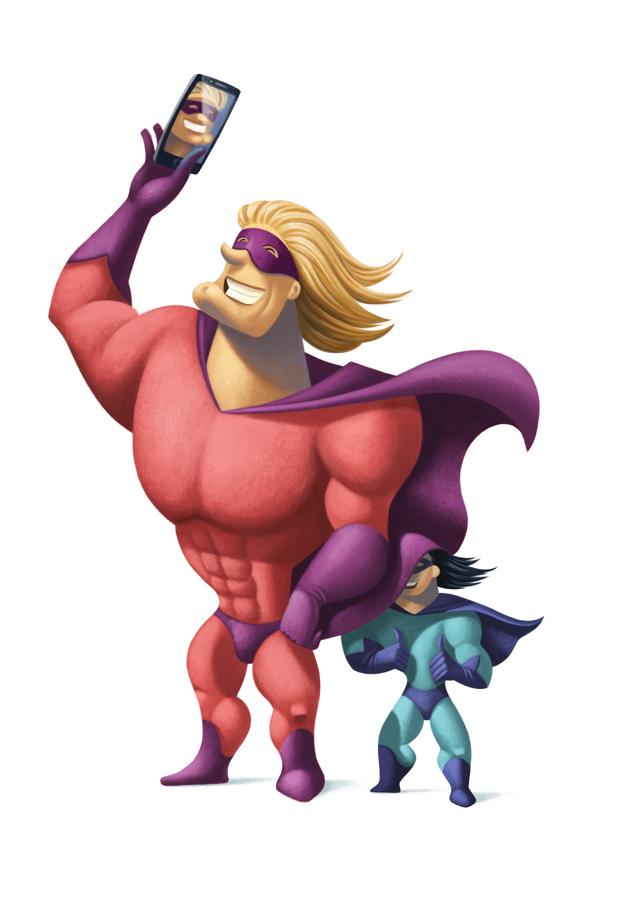
Though often associated with Batman and Robin, the word “sidekick’’ goes many places other than up the side of a building with the Caped Crusader. Recent headlines refer to movie sidekicks, Conan sidekick Andy Richter, and, in Mashable, a smart doorbell that “wants to be your crime-fighting sidekick.’’ A Vox article argues that some sidekicks are shortchanged: “Every semi-competent male hero has a more talented female sidekick. Why isn’t she the hero instead?’’ A Politico headline shows sidekick is an unwanted label in politics: “Christie: I’m not Trump’s sidekick.’’ That gets to the heart of this word: A sidekick is handy to have, but generally the job doesn’t look good on a resume. Even interns get more respect.
Many uses are entertainment-oriented. Sidekick often describes the Ed McMahon/Paul Shaffer type on a talk show or a second banana in a book, movie, or TV show, such as Sherlock Holmes’s helpful assistant, Watson, or Silent Bob’s obnoxious friend, Jay. In sports, you could think of supporting players, such as anyone who plays with LeBron James or Steph Curry, as sidekicks. A 2015 article in The Guardian protested the use of the label for Curry’s best teammate: “Klay Thompson is Steph Curry’s equal, not his sidekick.’’ That’s the whole problem with being a sidekick: You’re a partner, but not really.
That inequality makes the word tempting to use in relation to failed presidential candidates, who avoid the word like a bag of medical waste. When you’ve been trying to become the most powerful person in the world, the stigma of sidekickery can sting. A Bustle article unflatteringly described John Kasich as Ted Cruz’s “plucky sidekick.’’ A New York Times article titled “Chris Christie Adapts to New Role as Donald Trump Sidekick’’ affixes another dubious label to Christie: yes man. Though a yes man sounds more mature than a sidekick, the two roles are complementary: A sidekick is meant to follow, not lead. It’s an inherently emasculating role. Still, failed candidates might jump at the chance of becoming the ultimate sidekick: vice president.
Sidekick has had a more literal meaning since the early 1800s as a kick from or on the side. The oldest known use, from an 1809 book called “Oriental Field Sports,’’ is pretty solid advice: “It is highly imprudent to approach [a horse in India] within the reach of a yerk, or of a side kick.’’ From there, the term went metaphorical, referring to snide remarks. This sarcastic sense can be seen in an 1883 use in the New England Journal of Dentistry, which mentions an article “full of sneaking side kicks at somebody who is never mentioned.’’ In that example, sidekick is also a predecessor of the subtweet, in which a Twitter user takes a shot at an unnamed target. Fittingly, patron saint of sidekicks, Robin, is known for both kinds of literal sidekicks: He’s quick with his feet and wit.
Sidekick has had something close to its current meaning since the late 1800s. The first meaning recorded by the Oxford English Dictionary is from an extremely folksy use in an 1896 St. Louis Republic article: “W’en I was in New York dis side kick o’ mine says he’ll write me some letters.’’ The word has since referred to loyal associates, close companions, criminal cohorts, and other number twos. An 1899 article from the Spencer (Iowa) Herald describes someone as “a partner and side kick,’’ so the word has embodied a paradox for well over a century: A sidekick is a junior partner, which is a bit of an oxymoron. Sidekick has an alternate form in Australia: sidekicker.
Much of the disreputable flavor of sidekick comes from its prominence in comic books, at least older ones, and the immensely popular 1960s “Batman’’ television show. While Batman remains the epitome of cool for an ever-expanding circle of geeks, the same can’t be said for his pixie-booted partner. Jon Morris, author of “The League of Regrettable Superheroes’’ and the Gone and Forgotten blog, points out that after Robin was introduced in 1940 — borrowing a trend from dime novels — dozens of other comic book sidekicks popped up quickly. Aside from Captain America’s sidekick, Bucky, and Superman’s “pal’’ Jimmy Olsen, most sidekicks have been forgotten, and for good reason.
Morris describes the dubious duo of Airmail and Stampy, whose “power’’ was they couldn’t stop flying, so they needed to constantly weigh themselves down. Another preposterous pair, Nightmare and Sleepy, were “homeless itinerant professional wrestlers.’’ Nightmare wrestled in a tux, while Sleepy looked like “a little kid version of the Grim Reaper,’’ said Morris. With examples like Stampy and Sleepy, you can see why sidekick wasn’t a coveted position, not even among children, who the concept was meant to enthrall. As Morris suggested, the kids might have been perfectly happy identifying with Batman and other leads. It’s telling that in the recent flood of superhero movies and TV shows, sidekicks have been absent, even as absurd characters such as the telepathic Gorilla Grodd have appeared (on “The Flash’’).
Though the super type of sidekick is out of fashion, the concept remains familiar enough to keep the word prominent. In an e-mail, lexicographer Orin Hargraves mentioned another point in the favor of this word and concept — sidekicks are fun: “I don’t think it’s an embarrassing thing to be. Common adjectives that accompany ‘sidekick’ are: faithful, comedic, trusty, lovable, wise-cracking, plucky, goofy, wacky, sassy, spunky — many of which are appreciative. Maybe this also gives some insight as to why it’s a fun word, since the sidekick often seems to have an obligatory role to be funny.’’
That entertaining role was recently embraced by Kansas City Chief Travis Kelce, who put on a cape and mask to comfort and entertain children with cancer, saying to KMBC.com, “I’ve been a super sidekick all day.’’ There could be a lesson here. There are already enough grim, self-serious, wannabe leading men out there. The world could use a few more lighthearted, supportive pals.
Mark Peters is the author of the “Bull[expletive]: A Lexicon’’ from Three Rivers Press. Follow him on Twitter @wordlust.
 PREVIOUS ARTICLE