


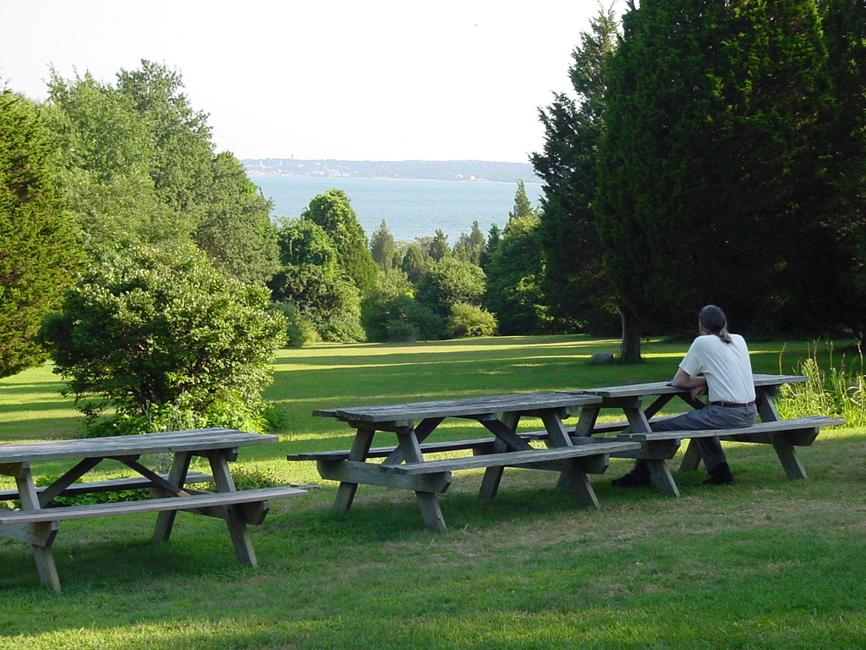
DUXBURY — The website for the Unitarian-affiliated Cedar Hill Retreat Center promises a “beautiful natural setting for relaxation and gatherings on 12 acres of fields enhanced by wildflowers, stately cedars, and 500 feet of pristine, private beach’’ for groups of up to 50 people — and the place on Kingston Bay is booked solid through the summer.
But a neighboring couple and a conservation group have filed a lawsuit to end the activity at the bucolic waterfront site, saying it violates a conservation restriction imposed on the property in 2008.
“The restriction says the activities there have to be spiritual, educational, or scientific, and they’re running a commercial operation — renting it out for family reunions, business celebrations, anniversary parties, wedding after-parties,’’ said Karen Grey, president of the Wildlands Trust of Southeastern Massachusetts, which is responsible for enforcing the conservation restriction.
She said this was the first time her organization has gone to court to force compliance with a conservation restriction and only the second time it has happened in Massachusetts.
The Wildlands Trust is responsible for 100 such restrictions on properties in 38 communities from Milton to Cape Cod, she added.
Jeffery A. Tocchio of Hingham, the attorney for Cedar Hill Retreat Center and its parent agency, the Ballou Channing District Unitarian Universalist Association, said they would not comment until they have submitted a legal response in Suffolk Superior Court, where the lawsuit was filed. He has until June 10 to respond, Tocchio said.
The suit was filed on May 4 by the Wildlands Trust and the John and Cynthia Reed Foundation. The Reeds live next door to the retreat center and donated $3 million in 2008 as an endowment to maintain the property so it could remain undeveloped under a formal conservation restriction.
John Reed, who moved to Duxbury in 2003, is a former chairman of Citigroup and the New York Stock Exchange and is active on the board of trustees for the Massachusetts Institute of Technology. He said the issue is about principles, not a neighborhood disturbance.
“I care an awful lot about nonprofits doing what they say they will do,’’ he said in a phone interview. “As somebody who has given a fair amount of money away, the thing that scares the death out of you is if you give money for purpose X and it turns out to be used for purpose Y. I really believe if you enter into an agreement, you should abide by it.’’
The retreat center is on Standish Street on a peninsula jutting into Kingston and Duxbury bays. A rutted dirt road lined with tall trees leads to a five-bedroom house with a rolling expanse of lawn down to a private beach.
The property, part of the original Myles Standish homestead, was owned in the 1800s by Stephen Allen, a Boston businessman and Standish descendant who bought much of the surrounding area.
Allen had unrealized plans to build a hotel and railroad spur to bring Boston guests to Duxbury. He also donated land for a monument to Standish on Captain Hill.
Allen left property to his son, Horace, who willed it to his three daughters: Beatrice, Rosamond, and Eleanor. They divided the land into three parts in 1939 and Rosamond Allen got the 12.2 acres at issue in the lawsuit.
In 1980, Rosamond Allen gave her land and the cottage on it to the Ballou Channing District Unitarian Universalist Association for use as a church retreat. The details of how the property should be used were laid out in a deed restriction in 1988, according to the lawsuit.
The property could be used only for “religious, aesthetic, scientific, and/or educational purposes’’ to protect it from development, the suit said.
But, the lawsuit contends, the Unitarian organization began selling beach permits and renting Cedar Hill to raise money to maintain the property.
The Reeds, who own 16 waterfront acres, had long been concerned about what they saw as commercial use of the property and the fact that the deed restriction was due to expire in 2010, according to the lawsuit.
The suit said that through their foundation, the Reeds proposed giving the Unitarians enough money to maintain the property without having to generate revenue — in exchange for a formal conservation restriction with the Wildlands Trust that would enforce Allen’s original intentions for the site. The Unitarian group and the Reed Foundation agreed the $3 million endowment would suffice, and local and state officials approved the agreement in 2008.
But the lawsuit contends that in 2010 Ballou Channing created a new organization, Cedar Hill Retreat Center Inc., to own and operate the property, and gave it only $1.4 million of the $3 million gift from the Reed Foundation.
The suit asks the court to award damages and require that all $3 million of the foundation gift be used to maintain the property. The suit also wants the court to stop Cedar Hill from “the ongoing operation of a commercial, revenue-generating enterprise and lodging house’’ and advertising it for rentals.
Grey said that the Wildlands Trust has been trying for seven years to resolve the issues with Cedar Hill.
“We want to make it really clear that this [lawsuit] was a last resort,’’ Grey said. “The bigger issue here is that we have a responsibility,’’ and the suit’s resolution “may set a precedent’’ for other conservation restrictions.
Johanna Seltz can be reached at seltzjohanna@gmail.com.
 PREVIOUS ARTICLE