


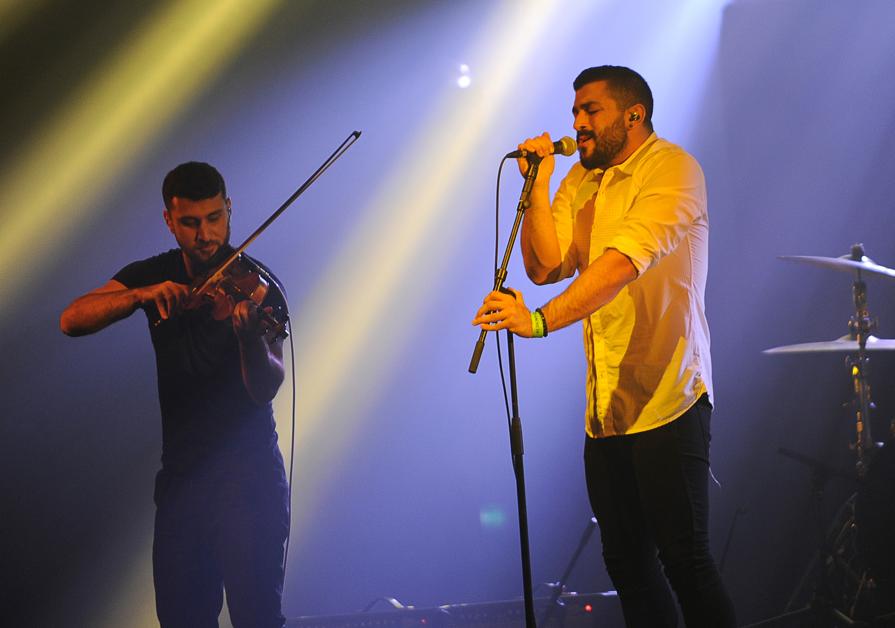
Mashrou’ Leila
At the Middle East Downstairs, Cambridge,
June 6 and 9 at 7 p.m. Tickets: $40, advance $30 day of show, two-day pass $50.
617-864-3278, www.mideastclub.com
‘Beirut is a beautiful city at night,’’ says Firas Abou Fakher, the guitarist and keyboard player of Mashrou’ Leila, the five-member band that’s one of the most exciting recent exports from the Lebanese capital’s nocturnal scene. “The dynamics of people at work or in the street, the social and political things that go on, they’re all so different at night. There’s a huge liberation for people’s desires.’’
Freeing desire from norms enforced by warring authorities is a good project for Beirut, with its history as a center of culture and trade surrounded by great violence. These days, it may be a good project for the world in general. Mashrou’ Leila leads by example, from the charisma of its singer, Hamed Sinno, an out gay man who sings of queer desire, to its rejection of the stale conceits of the Arabic pop industry.
What it’s doing is resonating. Formed in 2008 from a jam session among students at the American University of Beirut, Mashrou’ Leila (the name, referencing that origin, means “One-night project’’) became a cult favorite, then regional stars, filling venues across the Arab world.
Now, on the heels of its fourth album, “Ibn el Leil,’’ the band has embarked on its second North American tour, including two nights at the Middle East June 6 and 9. The tour began with a sold-out show in New York City and culminates in Toronto, where it plays the city’s Pride.
“Ibn el Leil’’ is a musical liberation for Mashrou’ Leila, as well. On prior records the band, at the time composed of seven members, played an art-rock style with tinges of cabaret nostalgia. The new sound is future-forward, with prominent keyboards and synths and a pacey, propulsive feel — things that happen when a rock band grows the confidence to make dance music.
“We were quite young when we started,’’ says Abou Fakher. “We had no grasp on what it meant to go into the studio and use it to craft a sound. What ended up on those early records was what we wrote in the jam room.’’ This time, the band decided to use the potential of studio tools in full. “The germination was all of us in late 2014 saying, let’s write stuff where we can dance.’’
Radio offerings in Lebanon and the Arab world badly need updating, Abou Fakher says. “It’s American Top 40 or Arab pop, which has been stagnant for 20 years: the same topics, the same clichéd videos. Everybody’s bored of it, but these huge production companies have a complete monopoly.’’
Mashrou’ Leila decided to make the pop music its members wanted to hear: danceable and with hooks, but progressive. “Obviously, sometimes our intuitions and desires go all over the place, with really huge outros, complex orchestrations, and things like that,’’ Abou Fakher says. “But that’s where it started.’’
As it happens, Mashrou’ Leila couldn’t help but get artsy with the new album’s signature track, the opener “Aoede.’’ It’s a glamorous monster of a song, with two full minutes of layered, swelling electronic intro before Sinno enters and carries the lyrics in a yearning falsetto. Aoede (also spelled Aoide) is the Greek muse of song, and the song is a prayer for her blessing and inspiration.
Accompanying the track is an extended video, shot on film in Beirut and on the high seas off the coast of Turkey, by director Noel Paul. Its story connects to the current tragedies swirling around Lebanon: the civil war in neighboring Syria, and the flow of refugees under desperate conditions across the eastern Mediterranean Sea.
The film shows a couple preparing for one of them to go away, perhaps forever. A man works on a ship carrying livestock, surrounding by fellow sailors yet completely alone. Powerful images — port equipment in eerie night light, cattle herded into pens — suffuse the screen.
“It’s a story that happened with our close friend,’’ Abou Fakher says — a Syrian man who worked as a sailor, but left the ship to seek refugee status in Spain. “Sailors have such a devotion to their ship, it’s almost treason. But extreme situations make you take decisions that profoundly affect everybody around you.’’
Mashrou’ Leila’s politics, as a band, are less ideological than emotional, in keeping with the idea of freeing desires. But politics often follows them. “Our songs get appropriated a lot,’’ Abou Fakher says. “They’re written from a very personal place, but they’re often used in movements, by students and others.’’
Recently, the band was forbidden from playing in Jordan before a scheduled concert in an arena where it had performed many times before. It seems that some religious leaders, both Muslim and Christian, objected to the lyrics. The ban was lifted after a massive fan outcry, but too late for the show to take place.
Abou Fakher says the incident was unsettling, but positive in a way: “We tend to be little monks; we go into our space and work. We forget the power of the song, and how the impact on even a single fan can be so strong, even life-saving. I don’t know where you can get so powerful a feeling from producing work. It’s a good one.’’
Mashrou’ Leila
At the Middle East Downstairs, Cambridge, June 6 and June 9 at 7 pm. Tickets: $40, advance $30 day of show, two-day pass $50. 617-864-3278, www.mideastclub.com
Siddhartha Mitter can be reached at siddharthamitter@gmail.com.
 PREVIOUS ARTICLE